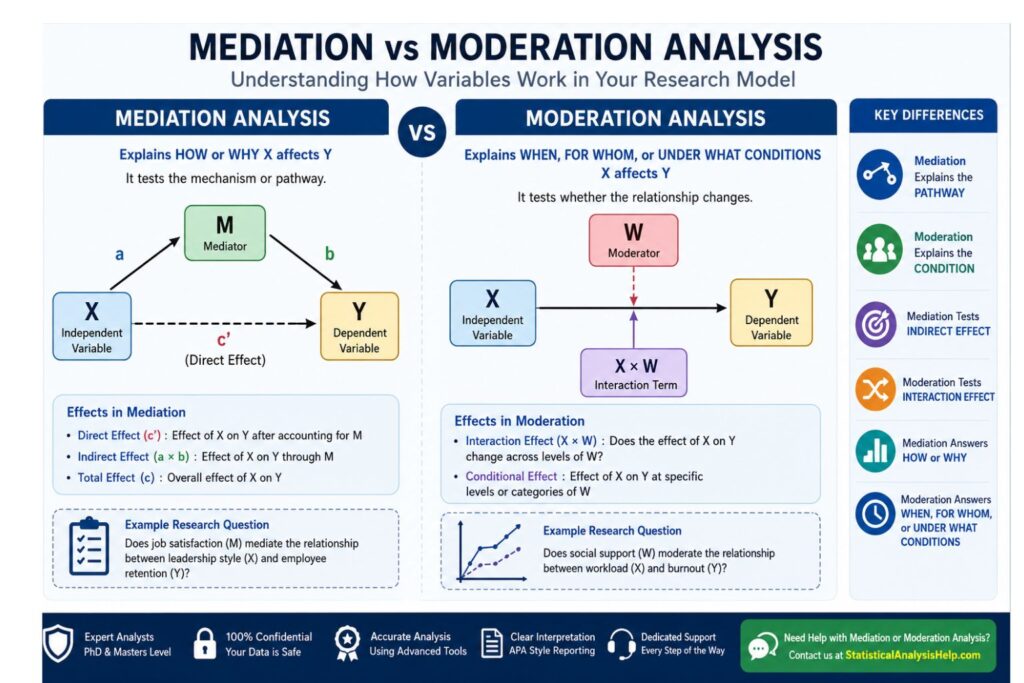
Mediation vs Moderation Analysis helps researchers understand the role of a third variable in a quantitative research model. Both mediation and moderation involve an additional variable beyond the independent and dependent variables, but they answer different questions. Mediation explains how or why one variable affects another. Moderation explains when, for whom, or under what conditions that relationship changes.
Need a tailored indirect-effect or interaction model?
This difference matters in dissertation data analysis, thesis research, psychology studies, healthcare projects, business research, education research, public health analysis, marketing research, and survey-based quantitative studies. If you choose the wrong model, you may select the wrong PROCESS Macro model, write incorrect hypotheses, misread SPSS output, or report findings that do not match your research questions.
For example, if leadership style improves employee retention because it increases job satisfaction, job satisfaction is a mediator. If leadership style affects employee retention more strongly among senior employees than junior employees, employee level is a moderator. The mediator explains the pathway. The moderator changes the relationship.
At StatisticalAnalysisHelp.com, we help students, researchers, and professionals choose the correct model, run mediation and moderation analysis in SPSS, PROCESS Macro, R, Stata, AMOS, SmartPLS, Jamovi, JASP, or other suitable tools, interpret output, create tables and plots, and write clear results for dissertations, theses, research papers, reports, and presentations.
Need help choosing between mediation and moderation?
Send your research topic, research questions, hypotheses, variable list, dataset, SPSS file, Stata file, R output, PROCESS Macro output, supervisor comments, or dissertation instructions. We can help you decide whether your third variable is a mediator, moderator, control variable, or part of a more advanced conditional process model. We can also run the analysis, interpret direct effects, indirect effects, interaction terms, conditional effects, confidence intervals, and prepare a clean write-up.
Mediation vs Moderation Analysis
The easiest way to understand mediation and moderation is to focus on the role of the third variable. A mediator explains the pathway between X and Y. A moderator changes the strength, direction, or condition of the relationship between X and Y.
| Feature | Mediation Analysis | Moderation Analysis |
|---|---|---|
| Main question | How or why does X affect Y? | When, for whom, or under what conditions does X affect Y? |
| Role of third variable | Explains the mechanism between X and Y | Changes the relationship between X and Y |
| What the third variable does | Acts as an intervening variable | Acts as a condition or boundary variable |
| Typical model | X → M → Y | X × W → Y |
| Main effect tested | Indirect effect | Interaction effect |
| Common statistical focus | Direct, indirect, and total effects | Conditional effects and simple slopes |
| Example question | Does job satisfaction mediate the relationship between leadership style and employee retention? | Does social support moderate the relationship between workload and burnout? |
| Common tools | SPSS, PROCESS Macro, R, Stata, AMOS, SmartPLS, Mplus | SPSS, PROCESS Macro, R, Stata, Jamovi, JASP |
| Output to interpret | Path coefficients, indirect effect, bootstrap confidence interval | Interaction coefficient, conditional effects, simple slopes, interaction plot |
| Best used when | Theory suggests a pathway or mechanism | Theory suggests a relationship differs across levels or groups |
| Common reporting phrase | M significantly mediated the relationship between X and Y. | W significantly moderated the relationship between X and Y. |
A mediator explains the pathway. A moderator changes the relationship. If your research question asks how or why, mediation may be appropriate. If it asks when, for whom, or under what conditions, moderation may be appropriate.
What Is Mediation Analysis?
Mediation analysis tests whether the relationship between an independent variable and dependent variable operates through a third variable called a mediator. The mediator explains the process, pathway, or mechanism through which X influences Y.
In a simple mediation model:
X → M → Y
Where:
- X is the independent variable.
- M is the mediator.
- Y is the dependent variable.
The researcher is not only asking whether X affects Y. The researcher is asking whether X affects M and whether M then affects Y. This makes mediation useful when the study aims to explain a mechanism rather than only prove that two variables are related.
For example, a researcher may want to know whether physical activity reduces depression symptoms. A mediation model may propose that physical activity improves sleep quality, and improved sleep quality then reduces depression symptoms. In that case, sleep quality is the mediator because it explains how physical activity may influence depression symptoms.
Mediation analysis usually involves three important effects.
| Effect | Meaning |
|---|---|
| Direct effect | The effect of X on Y after accounting for the mediator |
| Indirect effect | The effect of X on Y through the mediator |
| Total effect | The overall effect of X on Y before separating the mediated pathway |
Mediation is common in psychology, healthcare, education, business, management, marketing, public health, and social science research because many studies are interested in mechanisms. Researchers often want to know not only whether an effect exists, but also why it occurs.
Examples of mediation analysis include:
- Training improves job performance through employee confidence.
- Physical activity improves mental health through sleep quality.
- Socioeconomic status affects academic achievement through parental involvement.
- Leadership style affects employee retention through job satisfaction.
- Health education improves medication adherence through health literacy.
- Customer experience affects loyalty through customer satisfaction.
Mediation must be theory-driven. A variable should not be treated as a mediator simply because it appears between two variables in a dataset. The researcher must explain why X should affect M and why M should affect Y.
Not sure whether your third variable is a mediator? Send your research questions and variable list for model-selection support before running the wrong analysis.
What Is Moderation Analysis?
Moderation analysis tests whether the relationship between an independent variable and dependent variable changes depending on a third variable called a moderator. A moderator does not explain the pathway from X to Y. Instead, it changes the strength, direction, or condition of the relationship.
In a simple moderation model:
X × W → Y
Where:
- X is the independent variable.
- W is the moderator.
- Y is the dependent variable.
- X × W is the interaction term.
The key test in moderation is the interaction effect. If the interaction term is statistically significant, it suggests that the relationship between X and Y differs across levels or categories of W.
For example, a researcher may study whether workload predicts burnout. The researcher may believe that social support changes this relationship. Workload may predict burnout more strongly among people with low social support and less strongly among people with high social support. In this case, social support is the moderator.
Moderation analysis is useful when a researcher wants to understand context. It answers questions such as:
- Does the effect differ by gender?
- Is the relationship stronger among older or younger participants?
- Does social support weaken the effect of stress?
- Does income level change the link between satisfaction and loyalty?
- Does motivation change the effect of training on performance?
Examples of moderation analysis include:
- Training improves performance more strongly for employees with high motivation.
- Stress predicts anxiety more strongly among people with low social support.
- Customer satisfaction predicts loyalty more strongly among long-term customers.
- Health education improves adherence more strongly among patients with higher health literacy.
- Leadership style affects employee retention differently by job level.
- Advertising exposure affects purchase intention differently by age group.
Moderation is not interpreted by looking only at the main effects of X and W. The main focus is the interaction term and the conditional pattern of the relationship.
Need help testing an interaction effect? We can run moderation analysis in SPSS, PROCESS Macro, R, Stata, Jamovi, JASP, or another suitable statistical tool.
Mediator vs Moderator: The Core Difference
A mediator and moderator may both be third variables, but they play different roles in a research model. A mediator explains the process through which X affects Y. A moderator explains when or for whom the relationship between X and Y changes.
| Question | Mediator | Moderator |
|---|---|---|
| What does it explain? | The pathway or mechanism between X and Y | The condition under which X affects Y |
| Is it part of the causal pathway? | Usually yes | Usually no |
| Does it interact with X? | Not in simple mediation | Yes |
| What effect is tested? | Indirect effect | Interaction effect |
| What does significance mean? | X affects Y through M | The effect of X on Y depends on W |
| What is reported? | Direct, indirect, total effects, confidence interval | Interaction coefficient, simple slopes, conditional effects |
| What does the diagram look like? | X → M → Y | X × W → Y |
| Example statement | Job satisfaction mediates the effect of leadership style on retention. | Social support moderates the effect of stress on anxiety. |
| Common mistake | Calling any third variable a mediator without a theory-based pathway | Interpreting main effects instead of the interaction effect |
In plain language, mediation asks: What explains the relationship? Moderation asks: Does the relationship change depending on another variable?
A mediation result may be written as: “The mediator explains part of the relationship between X and Y.” A moderation result may be written as: “The moderator shows that the relationship between X and Y depends on W.”
When Should You Use Mediation Analysis?
Use mediation analysis when theory suggests that the independent variable affects an intermediate variable, which then affects the dependent variable. The mediator should make conceptual sense as part of the process.
Mediation is appropriate when:
- Theory suggests a causal pathway.
- The independent variable is expected to influence an intermediate variable.
- The intermediate variable is expected to influence the outcome.
- The research question asks how or why.
- The study has variables that support a logical sequence.
- The researcher wants to explain the mechanism behind an effect.
- The hypotheses are written around direct and indirect effects.
Examples of mediation research questions include:
- Does job satisfaction mediate the relationship between leadership style and employee retention?
- Does sleep quality mediate the relationship between physical activity and depression symptoms?
- Does academic motivation mediate the relationship between parental support and student achievement?
- Does perceived usefulness mediate the relationship between system quality and technology adoption?
- Does health literacy mediate the relationship between health education and medication adherence?
Mediation should not be selected just because a third variable exists. The variable must have a logical place in the model. If the variable changes the strength of the X-Y relationship rather than explaining the pathway, it may be a moderator instead.
When Should You Use Moderation Analysis?
Use moderation analysis when theory suggests that the relationship between X and Y differs depending on another variable. The moderator may be categorical, such as gender, treatment group, education level, employment status, or customer type. It may also be continuous, such as age, income, motivation, stress level, social support, or years of experience.
Moderation is appropriate when:
- The strength of the X-Y relationship may differ across groups or levels.
- The research question asks when, for whom, or under what conditions.
- The moderator is not part of the causal pathway.
- The researcher expects an interaction effect.
- Theory suggests that context changes the relationship.
- The researcher wants to compare how a predictor works at different levels of another variable.
Examples of moderation research questions include:
- Does gender moderate the relationship between stress and anxiety?
- Does age moderate the effect of training on job performance?
- Does social support moderate the relationship between workload and burnout?
- Does income level moderate the relationship between customer satisfaction and loyalty?
- Does organizational culture moderate the relationship between leadership style and employee engagement?
A common mistake is to interpret the main effect of the moderator instead of the interaction effect. In moderation analysis, the important question is whether the relationship between X and Y changes depending on W.
When Not to Use Mediation or Moderation Analysis
Mediation and moderation are powerful methods, but they are not suitable for every research model. Using them without a strong theoretical reason can make the analysis look forced and weaken the results chapter.
Do not use mediation analysis when there is no logical pathway from X to M to Y. If the proposed mediator does not clearly occur between the independent variable and outcome, mediation may not be defensible. Mediation also requires caution when the data are cross-sectional because the model implies a process, even when the study design does not prove time order.
Do not use moderation analysis when there is no theoretical reason to expect an interaction. A moderator should not be added simply to make the model more complex. If the research question does not ask whether the X-Y relationship changes across groups or levels, moderation may not be necessary.
You should also avoid mediation or moderation when:
- The variables are poorly measured.
- The sample size is too small for the model complexity.
- The third variable is actually a control variable.
- The hypotheses do not match the model.
- The proposed model is copied from another study without adapting it to your research.
- The software model number is chosen before the conceptual model is clear.
- The data structure does not support the proposed analysis.
Choosing the correct analysis starts with the research question, not the software. PROCESS Macro, SPSS, R, Stata, AMOS, and SmartPLS can only estimate the model you specify. They cannot decide whether the model makes theoretical sense.
Mediation and Moderation in Regression
Mediation and moderation are often tested using regression-based models. Regression allows researchers to estimate pathways, interaction terms, conditional effects, and model coefficients.
For mediation, the model usually examines several paths:
- Path a: X predicts M.
- Path b: M predicts Y while controlling for X.
- Path c: Total effect of X on Y.
- Path c′: Direct effect of X on Y after controlling for M.
- Indirect effect: The effect of X on Y through M, often represented as a × b.
The indirect effect is central to mediation analysis. Many modern mediation approaches use bootstrapped confidence intervals to test whether the indirect effect is statistically different from zero.
For moderation, the model includes:
- X as the independent variable.
- W as the moderator.
- X × W as the interaction term.
- Y as the dependent variable.
If the interaction term is significant, the researcher examines conditional effects or simple slopes. This shows how the relationship between X and Y behaves at different levels of the moderator.
Regression-based mediation and moderation require correct variable coding, careful model selection, assumptions checking, and accurate interpretation. A model may be technically correct but still poorly reported if the output is not explained clearly.
Mediation vs Moderation in SPSS, PROCESS Macro, R, Stata, and Other Tools
Mediation and moderation can be tested using several statistical tools. The best software depends on the data, model complexity, field of study, reporting requirements, and supervisor or journal expectations.
| Software | Mediation Support | Moderation Support | Best For |
|---|---|---|---|
| SPSS | Can test mediation through regression and PROCESS Macro | Can test interaction terms and PROCESS moderation models | Students and dissertation researchers using SPSS |
| PROCESS Macro | Strong support for mediation, moderation, and conditional process models | Strong support for interaction effects and moderated mediation | SPSS/SAS users needing Hayes PROCESS models |
| R | Supports mediation, moderation, SEM, and custom models | Supports interaction models, plots, and advanced analysis | Researchers needing flexible and reproducible analysis |
| Stata | Supports regression-based mediation and interaction models | Supports interactions and margins plots | Social science, economics, and public health research |
| AMOS | Supports mediation through SEM/path models | Can support moderation when modeled correctly | SEM-based mediation and latent variable models |
| SmartPLS | Supports mediation, moderation, and moderated mediation | Supports interaction effects in PLS-SEM | Business, management, and marketing research |
| Mplus | Strong support for complex mediation and SEM | Strong support for advanced moderation and multilevel models | Advanced researchers and complex models |
| Jamovi | Supports regression, mediation, and moderation modules | Supports user-friendly interaction analysis | Students who prefer menu-based analysis |
| JASP | Supports regression and some mediation/moderation workflows | Useful for simpler models and teaching contexts | Students and researchers needing accessible analysis |
| Excel | Limited support for preparation and simple summaries | Not ideal for advanced models | Basic preparation, charts, and reporting support |
PROCESS Macro is widely used for mediation, moderation, moderated mediation, and conditional process analysis in SPSS and SAS. It produces direct effects, indirect effects, bootstrap confidence intervals, interaction effects, conditional effects, and model summaries in a structured format.
However, software does not decide the correct model. The analysis must match the theory, research questions, hypotheses, variables, and study design.
Send your SPSS, PROCESS, R, or Stata output for interpretation support. We can help you understand coefficients, indirect effects, bootstrap confidence intervals, conditional effects, simple slopes, and interaction terms.
PROCESS Macro Models for Mediation and Moderation
PROCESS Macro is widely used for testing mediation, moderation, moderated mediation, and conditional process models. Each model number represents a different conceptual structure.
| PROCESS Model | Common Use | Typical Research Question |
|---|---|---|
| Model 4 | Simple mediation | Does M explain the relationship between X and Y? |
| Model 1 | Simple moderation | Does W change the relationship between X and Y? |
| Model 7 | Moderated mediation where the first stage is moderated | Does W change the effect of X on M, which then affects Y? |
| Model 14 | Moderated mediation where the second stage is moderated | Does W change the effect of M on Y within an indirect pathway? |
| Model 58 | Moderated mediation with more than one moderated path | Does W change multiple paths in the indirect effect? |
| Model 59 | More complex conditional process model | Are several pathways in the model conditional on W? |
Students should not choose a PROCESS model only because it looks advanced. Model 4 may be correct for simple mediation. Model 1 may be correct for simple moderation. A complex moderated mediation model should only be used when the theory and hypotheses justify it.
If your supervisor gave you a PROCESS model number but you are unsure how to run or interpret it, send the instructions and dataset for support.
Direct, Indirect, Total, Conditional, and Interaction Effects Explained
Mediation and moderation output includes several important effect terms. Understanding these terms helps you interpret the results correctly.
The direct effect is the effect of X on Y after accounting for the mediator. In mediation output, this is often called c′.
The indirect effect is the effect of X on Y through M. It is the core effect in mediation analysis and is often tested using bootstrapped confidence intervals.
The total effect is the overall effect of X on Y before separating the mediated pathway.
The conditional effect shows the effect of X on Y at specific values or categories of the moderator. It is common in moderation and moderated mediation.
The interaction effect shows whether the relationship between X and Y changes depending on W. In regression, this is tested using the X × W term.
Simple slopes show the X-Y relationship at different levels of W, such as low, average, and high levels of the moderator.
A bootstrap confidence interval is often used in mediation to test whether the indirect effect is statistically significant. If the confidence interval for the indirect effect does not include zero, the indirect effect is usually interpreted as significant.
The Johnson-Neyman region of significance can show the values of a continuous moderator at which the effect of X on Y becomes statistically significant or non-significant.
For mediation, focus on the indirect effect and its confidence interval. For moderation, focus on the interaction effect and the conditional pattern.
How to Interpret Mediation Analysis Results
Interpreting mediation analysis requires more than saying whether a p-value is significant. You need to explain what the indirect effect means in relation to the research question.
A significant indirect effect suggests that the mediator helps explain the relationship between the independent variable and the dependent variable. If X predicts M and M predicts Y, and the indirect effect is significant, the evidence supports mediation.
A non-significant indirect effect suggests that the proposed mediator may not explain the relationship between X and Y. This does not always mean the whole study has failed. It may mean that the pathway is weak, the mediator is not appropriate, the sample size is limited, or the theory needs revision.
A significant direct effect after including the mediator suggests that X still predicts Y after accounting for M. Some researchers call this partial mediation, although many modern reports focus more on the indirect effect and theoretical explanation than on the label.
A non-significant direct effect after including the mediator may suggest that the relationship between X and Y is largely explained through M. However, interpretation should still consider study design, measurement quality, variable ordering, and theory.
Sample mediation reporting templates include:
- “The indirect effect of X on Y through M was statistically significant, indicating that M helped explain the relationship between X and Y.”
- “The bootstrap confidence interval for the indirect effect did not include zero, supporting a mediation effect.”
- “After controlling for M, the direct effect of X on Y remained significant, suggesting that M partially explained the relationship.”
- “The mediation finding should be interpreted in relation to the study design, theory, and measurement quality.”
A good mediation write-up should state the paths tested, the indirect effect, the confidence interval, the direct effect, and the practical meaning of the finding.
How to Interpret Moderation Analysis Results
Moderation interpretation focuses on the interaction effect. A significant interaction means the relationship between X and Y differs depending on W.
If the interaction coefficient is positive, the effect of X on Y may become stronger as W increases. If the interaction coefficient is negative, the effect of X on Y may become weaker as W increases. The exact interpretation depends on how the variables are coded and scaled.
After finding a significant interaction, the researcher should examine simple slopes or conditional effects. These show how X relates to Y at different levels of the moderator. For example, the effect may be significant when social support is low but not significant when social support is high.
Interaction plots are useful because they show the moderation pattern visually. They can make it easier to explain whether the relationship becomes stronger, weaker, positive, negative, or non-significant at different levels of the moderator.
Sample moderation reporting templates include:
- “The interaction between X and W was statistically significant, indicating that the relationship between X and Y differed depending on W.”
- “Simple slopes analysis showed that X was more strongly associated with Y at high levels of W than at low levels of W.”
- “The conditional effect of X on Y was significant when W was high but not when W was low.”
- “The interaction plot indicated that W changed the strength of the relationship between X and Y.”
A significant moderator does not automatically mean the moderator causes the dependent variable. It means the X-Y relationship changes across levels of the moderator.
Common Mistakes in Mediation vs Moderation Analysis
Many errors in mediation and moderation analysis happen before the model is run. The biggest problem is usually a mismatch between the research question, variables, hypotheses, and statistical model.
Common mistakes include:
- Treating every third variable as a mediator.
- Calling a moderator a mediator.
- Choosing the wrong PROCESS model.
- Ignoring theory and causal order.
- Interpreting main effects instead of interaction effects in moderation.
- Reporting only p-values without confidence intervals.
- Ignoring bootstrapping for indirect effects.
- Using cross-sectional data without causal caution.
- Forgetting to code categorical moderators correctly.
- Misreading simple slopes.
- Using mediation when variables do not support a logical sequence.
- Using moderation when there is no theoretical reason for interaction.
- Failing to report model coefficients clearly.
- Not checking assumptions.
- Not aligning hypotheses with the analysis.
- Confusing moderated mediation with mediated moderation.
- Reporting PROCESS output without explaining it in plain language.
- Using complex models only because they appear more advanced.
- Failing to create interaction plots when needed.
- Copying generic interpretation without linking it to the study variables.
If your analysis has been rejected, questioned, or returned with supervisor comments, we can help review the model, output, interpretation, and write-up.
Mediation vs Moderation Analysis Examples
Examples make the difference between mediation and moderation easier to understand. Each example below shows the variables, research question, correct analysis, and short interpretation.
| Field | Variables | Research Question | Correct Analysis | Short Interpretation |
|---|---|---|---|---|
| Psychology | X = stress, M = sleep quality, Y = anxiety | Does sleep quality explain the relationship between stress and anxiety? | Mediation | Stress may increase anxiety partly because it reduces sleep quality. |
| Education | X = parental support, M = academic motivation, Y = achievement | Does motivation mediate the relationship between parental support and achievement? | Mediation | Parental support may improve achievement through stronger student motivation. |
| Business/management | X = leadership style, M = job satisfaction, Y = retention | Does job satisfaction explain the link between leadership and retention? | Mediation | Leadership may improve retention by increasing job satisfaction. |
| Healthcare | X = health education, W = health literacy, Y = medication adherence | Does health literacy change the effect of health education on adherence? | Moderation | Health education may work better for patients with higher health literacy. |
| Public health | X = physical activity, M = body weight, Y = blood pressure | Does body weight mediate the relationship between activity and blood pressure? | Mediation | Physical activity may affect blood pressure partly through changes in body weight. |
| Marketing | X = customer satisfaction, W = customer tenure, Y = loyalty | Does customer tenure moderate the relationship between satisfaction and loyalty? | Moderation | Satisfaction may predict loyalty more strongly among long-term customers. |
The correct analysis depends on the theory. The same variable can be a mediator in one study and a moderator in another if the research question changes.
Mediation, Moderation, Moderated Mediation, and Mediated Moderation
Mediation and moderation can also be combined into more complex models.
Mediation tests whether X affects Y through M. It focuses on the indirect pathway.
Moderation tests whether W changes the relationship between X and Y. It focuses on the interaction effect.
Moderated mediation tests whether an indirect effect changes depending on a moderator. For example, training may improve performance through confidence, but the indirect effect may be stronger for employees with high motivation.
Mediated moderation is more complex and examines whether a moderation effect is explained through a mediator. It should only be used when theory clearly supports the structure.
Moderated mediation and mediated moderation require careful model selection, variable ordering, and interpretation. These models can be powerful, but they can also be misused when researchers choose them without a strong theoretical reason.
Assumptions and Data Requirements
Mediation and moderation analysis require suitable data and careful preparation. Before running the model, you should consider the measurement level of variables, sample size, coding, assumptions, and hypothesis structure.
Important issues include:
- Measurement level of variables.
- Sample size adequacy.
- Linearity.
- Independence of observations.
- Multicollinearity.
- Normality of residuals where applicable.
- Homoscedasticity.
- Outliers.
- Missing data.
- Reliability of scales.
- Correct coding of categorical moderators.
- Centering or standardizing variables where useful.
- Causal caution when using cross-sectional data.
- Model fit issues where SEM is used.
- Clear alignment between hypotheses and variables.
Categorical moderators must be coded correctly. Continuous predictors and moderators may be mean-centered to make interpretation easier, especially when interaction terms are included. Scale reliability also matters because weak measurement can reduce the quality of the analysis.
Cross-sectional data can be used for some mediation models, but causal language should be used carefully. Mediation implies a pathway, so the research design and theory should support the proposed ordering of variables.
Who Needs Mediation and Moderation Analysis Help?
This service is useful for students, researchers, and professionals who understand their topic but struggle with model selection, statistical testing, software output, or results interpretation.
You may need help if you are:
- A dissertation student testing indirect effects.
- A thesis student using SPSS or PROCESS Macro.
- A PhD researcher working with a complex conceptual model.
- A master’s student confused about mediator vs moderator variables.
- A psychology student testing behavioral mechanisms.
- A business researcher studying leadership, satisfaction, or performance.
- A healthcare researcher studying intervention effects.
- A public health researcher testing pathways or conditional effects.
- An education researcher analyzing achievement, motivation, or support.
- A marketing researcher studying customer behavior.
- A social science researcher using survey data.
- An academic writer preparing results for a manuscript.
- A professional working with behavioral, organizational, or survey data.
Many clients know what they want to study but are unsure whether their third variable should be treated as a mediator, moderator, control variable, or part of a more complex conditional process model. We help clarify that before the analysis is done.
How We Help With Mediation and Moderation Analysis
StatisticalAnalysisHelp.com provides support for mediation analysis, moderation analysis, PROCESS Macro models, regression-based analysis, interpretation, tables, figures, and reporting.
We can help with:
- Choosing between mediation and moderation.
- Writing mediation or moderation hypotheses.
- Matching variables to the right model.
- Selecting the correct PROCESS Macro model.
- Preparing variables.
- Coding categorical moderators.
- Creating interaction terms.
- Running SPSS, PROCESS, R, Stata, AMOS, SmartPLS, or other models.
- Checking assumptions.
- Interpreting model output in clear language.
- Creating interaction plots.
- Explaining simple slopes.
- Writing results in APA style.
- Responding to supervisor or committee feedback.
- Preparing tables and figures.
- Revising unclear or rejected results sections.
Our goal is to help you avoid model confusion, run the correct analysis, and present the findings in a way your reader can understand.
Send your research questions, variables, dataset, and supervisor instructions for mediation or moderation analysis support.
Pricing for Mediation and Moderation Analysis Help
Pricing for mediation and moderation analysis depends on the complexity of the model and the deliverables required. A simple mediation model with a clean dataset usually costs less than a moderated mediation model requiring assumptions checks, interaction plots, multiple hypotheses, APA-style reporting, and supervisor feedback revisions.
| Service Need | What It May Include | Pricing Basis |
|---|---|---|
| Simple mediation analysis | Model setup, indirect effect testing, interpretation | Quote based on variables and software |
| Simple moderation analysis | Interaction term, conditional effects, simple slopes | Quote based on model and output needed |
| PROCESS Macro model setup | Model selection, variable placement, settings, output review | Quote based on PROCESS model number and hypotheses |
| PROCESS output interpretation | Explanation of coefficients, effects, confidence intervals | Quote based on output length and reporting needs |
| Full dissertation mediation/moderation support | Model selection, analysis, tables, figures, APA write-up | Custom quote |
| Moderated mediation analysis | Conditional indirect effects, index of moderated mediation, interpretation | Quote based on complexity |
| APA-style results reporting | Results section, tables, interpretation, figure notes | Quote based on formatting and scope |
| Correction of supervisor feedback | Review comments, revise analysis or write-up | Quote based on feedback volume |
| Urgent analysis support | Faster review, analysis, and reporting where possible | Quote based on deadline and scope |
Pricing depends on:
- Number of variables.
- Number of hypotheses.
- Number of models.
- Software required.
- Dataset condition.
- Whether assumptions must be checked.
- Whether plots and tables are needed.
- Whether APA reporting is required.
- Deadline.
- Revision scope.
- Whether supervisor comments need to be addressed.
If your website uses exact pricing, you can replace the quote-based wording with editable placeholders such as:
- Simple mediation analysis: from $___
- Simple moderation analysis: from $___
- PROCESS Macro interpretation: from $___
- Full dissertation results support: custom quote
For an accurate quote, send your research questions, hypotheses, dataset, software preference, supervisor comments, required deliverables, and deadline. We will review the scope and tell you what level of support is needed before work begins.
Why Trust StatisticalAnalysisHelp.com?
Mediation and moderation analysis require more than pressing a button in SPSS or PROCESS Macro. The model must fit the research question, the variables must be placed correctly, the output must be interpreted accurately, and the write-up must explain the findings clearly.
Clients trust StatisticalAnalysisHelp.com because we support:
- Academic, research, and professional projects.
- Statistical interpretation, not just software output.
- Clear explanation of results.
- Confidential handling of files.
- SPSS, PROCESS Macro, R, Stata, AMOS, SmartPLS, Excel, and other tools.
- Both analysis and reporting.
- Custom support based on research questions.
- No generic templates.
- Assistance with supervisor comments.
- Practical communication.
- Tables, plots, and APA-style write-up.
- Students who need results explained in simple language.
Your files are handled confidentially and used only for the requested project. You can anonymize personal identifiers before sharing your data. We can also work from partial instructions, supervisor comments, exported output, or draft results if you are not sure where the problem is.
We do not promise guaranteed grades, publication, or approval. We focus on helping you run the right analysis, understand the results, and present them clearly.
What You Receive
Deliverables depend on your project scope. Some clients only need model selection guidance. Others need full analysis, interpretation, tables, plots, and APA-style reporting.
Depending on your project, you may receive:
- Model selection guidance.
- Cleaned or prepared analysis file where applicable.
- Mediation or moderation output.
- PROCESS Macro output interpretation.
- Regression tables.
- Direct effect interpretation.
- Indirect effect interpretation.
- Total effect interpretation.
- Conditional effect interpretation.
- Interaction effect interpretation.
- Simple slopes explanation.
- Interaction plot where applicable.
- APA-style results write-up.
- Assumption check summary.
- Explanation notes.
- Tables and figures.
- Revised results after feedback where agreed.
Each deliverable is matched to the research question, software, deadline, and reporting instructions.
Frequently Asked Questions About Mediation vs Moderation Analysis
What is the difference between mediation and moderation analysis?
Mediation analysis explains how or why X affects Y through a mediator. Moderation analysis tests whether the relationship between X and Y changes depending on a moderator. Mediation focuses on indirect effects, while moderation focuses on interaction effects.
What is the difference between a mediator and a moderator?
A mediator is part of the pathway between the independent variable and dependent variable. A moderator changes the strength, direction, or condition of the relationship between the independent variable and dependent variable.
How do I know whether my variable is a mediator or moderator?
Look at your research question. If the variable explains how X affects Y, it may be a mediator. If it changes when or for whom X affects Y, it may be a moderator. Theory and variable ordering are important.
Can the same variable be a mediator in one study and a moderator in another?
Yes. The role of a variable depends on the research question and theoretical model. For example, social support may mediate one relationship in one study and moderate another relationship in a different study.
What software is best for mediation and moderation analysis?
SPSS with PROCESS Macro is common for dissertation and thesis projects. R, Stata, AMOS, SmartPLS, Mplus, Jamovi, and JASP can also be used depending on the model, data, and reporting requirements.
What is PROCESS Macro used for?
PROCESS Macro is used for mediation, moderation, moderated mediation, and conditional process analysis. It helps estimate direct effects, indirect effects, interaction effects, conditional effects, bootstrap confidence intervals, and simple slopes.
Which PROCESS model is used for mediation?
PROCESS Model 4 is commonly used for simple mediation. More complex mediation models may require different approaches depending on the number of mediators and research hypotheses.
Which PROCESS model is used for moderation?
PROCESS Model 1 is commonly used for simple moderation. It tests whether the interaction between X and W predicts Y.
What does a significant indirect effect mean?
A significant indirect effect means that the mediator helps explain the relationship between the independent variable and the dependent variable. In many reports, the bootstrap confidence interval is used to determine whether the indirect effect is significant.
What does a significant interaction effect mean?
A significant interaction effect means that the relationship between X and Y changes depending on the moderator. The researcher should examine conditional effects, simple slopes, or an interaction plot to explain the pattern.
Do I need a large sample size for mediation or moderation?
Sample size requirements depend on the number of variables, effect sizes, reliability, model complexity, and analysis method. More complex models usually require larger samples. A small sample can reduce statistical power and make effects harder to detect.
Can mediation be tested with cross-sectional data?
Mediation can be tested with cross-sectional data, but causal language should be used carefully. Mediation implies a pathway, so the interpretation should be guided by theory, study design, and measurement limitations.
Should I use SPSS, R, Stata, AMOS, or SmartPLS?
The best tool depends on your model, data type, supervisor requirements, and reporting format. SPSS with PROCESS Macro is common for regression-based models. AMOS and SmartPLS are often used when the model involves SEM or latent constructs. R and Stata offer more flexible analysis options.
Can you help me interpret SPSS or PROCESS Macro output?
Yes. You can send your SPSS or PROCESS Macro output, and we can help interpret coefficients, p-values, confidence intervals, indirect effects, conditional effects, simple slopes, and interaction plots.
Can you write mediation and moderation results in APA style?
Yes. We can help write mediation and moderation results in APA-style language, including coefficients, confidence intervals, model summaries, indirect effects, interaction effects, and interpretation.
How much does mediation or moderation analysis help cost?
The cost depends on the number of variables, hypotheses, models, software, dataset condition, deadline, assumptions, plots, tables, APA reporting, and revision needs. Send your project details for a custom quote.
How do I order mediation or moderation analysis help?
Send your research topic, research questions, hypotheses, variables, dataset, software preference, supervisor comments, deadline, and required deliverables. We will review the scope and guide you on the next step.
Order Mediation vs Moderation Analysis Help
Order Mediation vs Moderation Analysis help if you need support choosing the right model, running the correct analysis, interpreting output, writing findings, creating tables, preparing plots, or responding to supervisor feedback.
You can send your research topic, research questions, hypotheses, variable list, dataset, software preference, supervisor feedback, PROCESS model number if known, deadline, rubric, and formatting instructions. StatisticalAnalysisHelp.com can help you select the correct model, run the analysis, interpret the output, create figures, write APA-style results, and prepare a clean report.
Whether you need simple mediation, simple moderation, PROCESS Macro interpretation, moderated mediation, dissertation results support, or correction of supervisor comments, we can help you move from confusing output to clear, report-ready findings.