
Survey Data Analysis Help
Collected survey responses are only useful when they are cleaned, coded, analyzed, interpreted, and reported correctly. Many students, researchers, and professionals complete the data collection stage but struggle when it is time to turn questionnaire responses into meaningful results. The dataset may contain missing responses, unclear variable names, confusing Likert scale items, open-ended comments, multiple-response […]
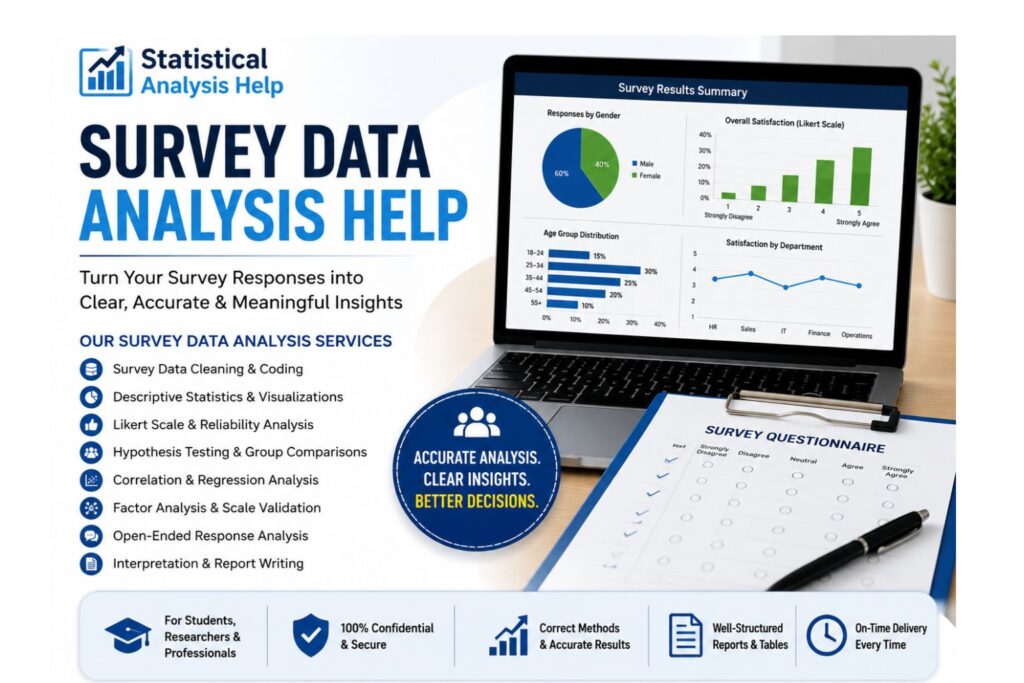
Collected survey responses are only useful when they are cleaned, coded, analyzed, interpreted, and reported correctly. Many students, researchers, and professionals complete the data collection stage but struggle when it is time to turn questionnaire responses into meaningful results. The dataset may contain missing responses, unclear variable names, confusing Likert scale items, open-ended comments, multiple-response questions, or SPSS output that is difficult to explain. Without the right analysis plan, even a well-designed survey can lead to weak findings, unclear tables, and supervisor feedback that requires major revisions.
At Statistical Analysis Help, we provide expert Survey Data Analysis Help for students, dissertation writers, thesis candidates, academic researchers, business analysts, healthcare researchers, education researchers, psychology students, public health researchers, nursing researchers, and social science researchers. We help you move from raw survey data to clean, accurate, and report-ready results. Our support covers survey data cleaning, questionnaire coding, descriptive statistics, Likert scale analysis, hypothesis testing, reliability analysis, correlation, regression, factor analysis, open-ended response analysis, charts, tables, interpretation, and results writing.
Whether you are working on a dissertation, thesis, research project, business survey, customer satisfaction study, employee engagement survey, healthcare questionnaire, education survey, or academic report, we can help you choose the correct statistical approach and explain the findings clearly. Send us your questionnaire, dataset, research questions, and instructions, and we will help you prepare a survey analysis that is accurate, organized, and easy to understand.
Expert Survey Data Analysis Help for Students and Researchers
Our survey data analysis service is designed for anyone who has collected questionnaire responses and needs help making sense of the results. You may have collected data through Google Forms, Qualtrics, SurveyMonkey, KoboToolbox, REDCap, Microsoft Forms, paper questionnaires, institutional survey systems, or customer feedback platforms. Once the responses are exported, we help organize the dataset, prepare the variables, select the right tests, and interpret the results based on your objectives.
We support undergraduate students, master’s students, PhD candidates, dissertation students, thesis students, academic researchers, business researchers, healthcare researchers, nursing researchers, public health students, psychology students, education researchers, social science researchers, monitoring and evaluation teams, and professionals preparing survey reports. Some clients only need simple summaries such as frequencies, percentages, and charts. Others need advanced analysis such as Cronbach’s alpha, factor analysis, chi-square tests, t tests, ANOVA, correlation, multiple regression, logistic regression, ordinal logistic regression, or nonparametric tests.
Our goal is not just to run statistical software and send output. We help you understand what the results mean and how they answer your research questions. For broader projects that are not limited to questionnaires, you may also need our Data Analysis Help or Statistical Data Analysis Help. This page, however, focuses specifically on survey and questionnaire data.
What Is Survey Data Analysis?
Survey data analysis is the process of transforming questionnaire responses into useful findings. It involves reviewing the dataset, cleaning errors, coding responses, summarizing patterns, comparing groups, testing relationships, checking reliability, interpreting statistical output, and presenting the findings in a clear report. A strong survey analysis does not simply show numbers; it explains what the responses mean in relation to the research questions, hypotheses, or decision-making goals.
Survey data often includes different types of questions, and each type requires the correct treatment. Closed-ended questions may require frequencies, percentages, and cross-tabulations. Likert scale questions may require item-level summaries, composite scores, reliability checks, group comparisons, or regression analysis. Multiple-response questions need careful coding because one respondent can select several answers. Ranking questions may require rank-based summaries or nonparametric methods. Open-ended questions may require coding, categorization, theme development, and qualitative interpretation.
Good survey data analysis connects the questionnaire design with the final report. It helps readers understand who responded, what they said, whether responses differed across groups, whether variables were related, and whether the findings support the research questions or hypotheses. This is why correct coding, test selection, interpretation, and reporting are important.
Why Survey Data Analysis Often Becomes Difficult
Survey analysis often becomes difficult because raw responses are rarely ready for final reporting. A dataset exported from a survey platform may contain incomplete responses, duplicate entries, spelling variations, inconsistent coding, unclear column names, empty cells, or responses that need recoding before analysis. If these issues are not fixed early, they can affect the accuracy of descriptive statistics, reliability analysis, hypothesis testing, regression models, and final interpretation.
Another major challenge is choosing the right statistical test. A student may know the research question but not know whether to use a chi-square test, t test, ANOVA, correlation, regression, logistic regression, Spearman correlation, Mann-Whitney U test, or Kruskal-Wallis test. The correct choice depends on the type of variables, number of groups, sample size, distribution of the data, assumptions, and study design. Running the wrong test can lead to incorrect conclusions and supervisor feedback that requires major revisions.
Likert scale data creates additional confusion because many questionnaires use several items to measure one construct, such as satisfaction, service quality, motivation, anxiety, leadership style, academic engagement, patient experience, or customer loyalty. These items may need reliability analysis before they are combined into a composite score. Some items may also be reverse-coded, meaning they must be transformed before scoring. We help identify these issues and choose an analysis plan that matches your questionnaire and research objectives.
Our Survey Data Analysis Service Covers
Survey Data Cleaning
Survey data cleaning is the foundation of accurate analysis. Before running statistical tests, we check whether the dataset is complete, consistent, and correctly structured. This may involve reviewing missing values, duplicate responses, incomplete cases, invalid entries, outliers, formatting issues, inconsistent response labels, and variables that are not ready for analysis. Clean data helps prevent mistakes that can weaken the credibility of your results.
We also check whether your variables are properly named, labeled, and coded. For example, if a satisfaction question uses values from 1 to 5, the dataset should clearly identify what each value means. If one question uses “Strongly Agree” as text while another uses the number 5, the responses may need to be standardized. If your survey includes reverse-worded questions, those items may need reverse coding before reliability analysis or composite score creation. These details matter because poor preparation can produce misleading results even when the statistical test is correct.
Questionnaire Coding
Questionnaire coding converts survey responses into a format that statistical software can analyze. We help code demographic variables, categorical responses, Likert scale items, ranking questions, multiple-response questions, reverse-coded items, open-ended comments, and composite scores. Proper coding makes the dataset easier to analyze and helps ensure that the output matches the questionnaire structure.
For SPSS, questionnaire coding may include setting variable names, value labels, missing value codes, measurement levels, and scale scores. For Excel, it may include organizing columns, cleaning responses, preparing pivot tables, and creating summary sheets. For R or Stata, it may involve recoding variables, creating analysis-ready datasets, and preparing reproducible commands. Correct coding is especially important when the survey has many sections, multiple constructs, or several response formats.
Descriptive Survey Analysis
Descriptive survey analysis summarizes the basic patterns in your responses. It helps show who participated in the survey, how respondents answered each question, and what the overall response trends look like. We can prepare frequencies, percentages, means, medians, standard deviations, minimum values, maximum values, response distributions, demographic tables, and item-by-item summaries.
This type of analysis is useful for almost every survey project. A dissertation may need demographic summaries before presenting hypothesis tests. A business survey may need percentages showing customer satisfaction, service experience, or product feedback. A healthcare survey may need to show how often respondents experience certain barriers or behaviors. Descriptive results provide the foundation for more advanced analysis because they help readers understand the sample and the response patterns before moving to inferential statistics.
Likert Scale Analysis
Likert scale analysis is one of the most common areas where students and researchers request help. Likert questions are often used to measure agreement, satisfaction, importance, frequency, perception, attitude, confidence, motivation, or intention. Although these questions look simple, the analysis can become complicated when several items are grouped together to measure one construct.
We help analyze single Likert items, multi-item scales, composite scores, reverse-coded items, agreement levels, satisfaction scores, perception scales, and attitude measures. Depending on your research question, we may use frequencies, percentages, medians, means, standard deviations, reliability analysis, correlation, regression, t tests, ANOVA, Mann-Whitney U tests, Kruskal-Wallis tests, or factor analysis. We also help explain why a specific approach is suitable for your survey, which is especially important for dissertations and thesis projects.
Reliability Analysis
Reliability analysis checks whether several questionnaire items measure the same concept consistently. This is important when your survey includes constructs such as job satisfaction, service quality, motivation, anxiety, leadership style, academic engagement, patient satisfaction, employee commitment, or customer loyalty. If items are combined into one scale without checking reliability, the final score may not be dependable.
We help calculate and interpret Cronbach’s alpha, review item-total statistics, check whether items fit the scale, identify weak items, and create composite scores where appropriate. We also help explain the reliability results clearly in your report. This support is especially useful for dissertation students, psychology researchers, education researchers, healthcare researchers, business students, and social science researchers using multi-item questionnaires.
Cross-Tabulation and Group Comparison
Many surveys require comparisons between groups. You may want to know whether satisfaction differs by gender, whether attitudes differ by age group, whether employees in different departments report different experiences, or whether education level is associated with awareness. Group comparison helps you move beyond general summaries and examine whether important differences exist within the data.
We help with cross-tabulation, chi-square tests, independent samples t tests, paired samples t tests, one-way ANOVA, repeated measures ANOVA, Mann-Whitney U tests, Wilcoxon signed-rank tests, Kruskal-Wallis tests, and post hoc tests. The right method depends on the type of variables, number of groups, distribution of the data, and research question. For broader testing support, you can also use our Hypothesis Testing Help and Inferential Statistics Help.
Correlation and Regression Analysis
Survey research often involves questions about relationships and predictors. You may want to know whether service quality is related to customer satisfaction, whether stress predicts academic performance, whether training predicts employee confidence, or whether attitude predicts intention to use a product. Correlation and regression help answer these types of questions when the variables are suitable.
We help with Pearson correlation, Spearman correlation, linear regression, multiple regression, logistic regression, and ordinal logistic regression. We also help interpret coefficients, p-values, confidence intervals, model fit, direction of relationships, predictor strength, and practical meaning. If your project needs deeper support, our Regression Analysis Help and Logistic Regression Help pages may also be useful.
Factor Analysis and Scale Validation
Factor analysis is useful when you need to examine the structure of a questionnaire or validate a scale. This method helps identify whether survey items group together into meaningful factors or constructs. It is commonly used in psychology, education, management, marketing, public health, nursing, and social science research.
We help with exploratory factor analysis, principal component analysis, KMO test, Bartlett’s test, eigenvalues, factor loadings, rotated component matrices, factor naming, and interpretation. Factor analysis output can be difficult to understand because it contains several tables and decisions. We help explain what the results mean and how to present them clearly without overclaiming what the data shows.
Open-Ended Survey Response Analysis
Some surveys include open-ended questions where respondents explain their experiences, opinions, or feedback in their own words. These responses can add important depth to a survey report, but they cannot be analyzed in the same way as numeric responses. They need coding, categorization, theme development, and careful interpretation.
We help code open-ended survey responses, create response categories, identify themes, summarize common views, count theme frequencies where appropriate, and select representative comments. This is useful for mixed-methods studies, customer feedback surveys, employee engagement surveys, education surveys, healthcare surveys, and public opinion projects. We can also help integrate open-ended findings with quantitative results so the final report feels connected and complete.
Survey Data Visualization
Survey results are easier to understand when they are presented using clear tables, charts, and figures. We help create visuals that match your research questions and reporting style. These may include frequency tables, demographic tables, crosstab tables, Likert scale charts, bar charts, stacked bar charts, mean comparison charts, correlation tables, regression tables, reliability tables, and factor analysis tables.
For academic projects, we prepare clean tables and figures that fit dissertation, thesis, and research report standards. For business projects, we prepare visuals that support presentations, executive summaries, and decision-making. Good visualization does not overload the reader with unnecessary graphics. It highlights the most important findings and makes the results easier to understand.
Survey Results Interpretation and Report Writing
Survey data analysis is incomplete if the results are not explained clearly. Many students and researchers can generate output, but they struggle to write what the output means. We help interpret results in relation to the research questions, hypotheses, objectives, and study context.
We can help prepare dissertation Chapter 4, thesis results sections, research report findings, business survey reports, academic results sections, presentation summaries, and survey findings narratives. We explain statistical significance, non-significant results, group differences, relationships, predictors, and limitations in clear language. If you already have SPSS, Excel, R, or Stata output but cannot explain it, we can help turn the output into a complete results section.
Send your survey dataset, questionnaire, and instructions today, and we will help you clean, analyze, interpret, and report your findings correctly.
Types of Survey Data We Can Analyze
| Survey data type | Examples | Suitable analysis |
|---|---|---|
| Demographic data | Age group, gender, education level, job role, department | Frequencies, percentages, cross-tabulations |
| Categorical data | Yes/no responses, selected categories, group membership | Frequencies, chi-square tests, crosstabs |
| Likert scale data | Agreement, satisfaction, importance, frequency scales | Percentages, medians, means, reliability, group comparisons, regression |
| Continuous numeric responses | Age, income, test scores, total scale scores | Descriptive statistics, correlation, regression, t tests, ANOVA |
| Ranking questions | Preference ranking, priority ranking | Rank summaries, median ranks, nonparametric tests |
| Multiple-response questions | “Select all that apply” questions | Multiple-response frequencies, percentages, subgroup comparisons |
| Open-ended responses | Comments, explanations, written feedback | Coding, theme development, qualitative summaries |
| Pre-test/post-test survey responses | Before-and-after intervention surveys | Paired t tests, Wilcoxon tests, repeated measures analysis |
| Longitudinal survey responses | Responses collected over several time points | Trend analysis, repeated measures, advanced modeling where appropriate |
Survey Data Analysis Methods We Can Help With
| Method | When it is used | What it helps answer |
|---|---|---|
| Frequencies and percentages | Categorical survey responses | How many respondents selected each answer? |
| Descriptive statistics | Numeric or scale variables | What is the average, spread, or pattern of responses? |
| Cross-tabulation | Comparing two categorical variables | How do responses differ by group? |
| Chi-square test | Testing association between categorical variables | Is there a significant relationship between two categories? |
| Independent samples t test | Comparing two independent groups | Do two groups differ in their mean score? |
| Paired samples t test | Comparing two related measurements | Did scores change before and after an intervention? |
| One-way ANOVA | Comparing three or more groups | Do several groups differ in their mean scores? |
| Repeated measures ANOVA | Comparing repeated measurements | Do responses change across time or conditions? |
| Mann-Whitney U test | Nonparametric comparison of two groups | Do two groups differ when data are ordinal or non-normal? |
| Kruskal-Wallis test | Nonparametric comparison of several groups | Do three or more groups differ on an ordinal or non-normal measure? |
| Pearson correlation | Testing relationship between continuous variables | Are two variables linearly related? |
| Spearman correlation | Testing relationship between ordinal or non-normal variables | Are two ranked variables associated? |
| Linear regression | Predicting a continuous outcome | Which variable predicts the outcome? |
| Multiple regression | Predicting an outcome using several predictors | Which predictors explain the outcome? |
| Logistic regression | Predicting a binary outcome | Which factors predict a yes/no outcome? |
| Ordinal logistic regression | Predicting an ordered outcome | Which factors predict ordered categories? |
| Reliability analysis | Testing internal consistency | Do several items measure the same construct? |
| Factor analysis | Exploring questionnaire structure | Which items group into meaningful factors? |
| Cluster analysis | Grouping respondents | Are there meaningful respondent segments? |
| Thematic analysis | Interpreting open-ended responses | What common themes appear in written answers? |
Survey Data Analysis Software We Support
SPSS Survey Data Analysis Help
SPSS is one of the most common tools for dissertation, thesis, psychology, education, business, healthcare, and social science survey analysis. It is useful for descriptive statistics, crosstabs, chi-square tests, t tests, ANOVA, reliability analysis, correlation, regression, factor analysis, and output interpretation. Many students use SPSS because it produces organized tables and is widely accepted in academic research.
We help set up SPSS files correctly, define variables, assign value labels, code missing values, run the required tests, and interpret the output. We can also help identify which SPSS tables matter and which ones should not be included in the final report. If your project is mainly SPSS-based, you may also need our SPSS Data Analysis Help.
Excel Survey Data Analysis Help
Excel is useful for basic survey summaries, simple charts, pivot tables, data cleaning, and presentation-ready reports. It works well when the survey is not too complex and the analysis mainly requires frequencies, percentages, summaries, and visuals.
We help organize your survey responses in Excel, clean columns, prepare summary tables, create charts, and structure the workbook so the results are easier to review. If your project requires advanced statistical tests, we may recommend SPSS, R, Stata, Jamovi, or JASP instead.
R Survey Data Analysis Help
R is useful for advanced survey analysis, reproducible coding, data cleaning, visualization, and complex statistical procedures. It is a strong option when your project requires flexibility, automation, advanced modeling, or a transparent record of the analysis steps.
We help clean survey data in R, recode variables, create composite scores, run statistical tests, generate plots, and prepare reproducible scripts. R is especially useful for larger datasets, repeated analysis, advanced visualizations, and projects where reproducibility matters.
Stata Survey Data Analysis Help
Stata is commonly used in public health, economics, policy research, epidemiology, development studies, and survey-weighted analysis. It is useful for descriptive statistics, regression modeling, subgroup comparisons, weighting, and advanced quantitative research.
We help prepare survey data in Stata, run appropriate commands, interpret output, and explain findings clearly. This is useful when your survey includes complex sampling, population weights, panel elements, or policy-related analysis.
Jamovi and JASP Survey Data Analysis Help
Jamovi and JASP are useful for students who need a simpler interface for statistical analysis. They can handle descriptive statistics, t tests, ANOVA, correlation, regression, reliability analysis, and several common academic tests. These tools are often easier for beginners than more technical software.
We help users choose the right analysis, run the tests, interpret the results, and prepare written explanations. This support is useful for students who need clear statistical output without complex coding.
Power BI or Tableau Survey Dashboard Support
Some survey projects require dashboards instead of traditional academic reports. This is common in business surveys, monitoring and evaluation, institutional research, employee feedback, customer satisfaction studies, and organizational reporting.
We can help prepare cleaned survey data, create summary measures, structure dashboard-ready files, and design meaningful charts for Power BI or Tableau. Dashboard support is useful when the results need to be updated, shared with stakeholders, or presented visually for decision-making.
Dissertation Survey Data Analysis Help
Dissertation and thesis survey analysis must align with the research questions, hypotheses, questionnaire design, methodology chapter, and university guidelines. A strong dissertation analysis does not run every possible test. It selects the tests that directly answer the study questions and explains the findings in a clear academic format.
We help dissertation and thesis students with research question alignment, hypothesis testing, questionnaire coding, survey data cleaning, Likert scale analysis, reliability analysis, descriptive statistics, inferential statistics, SPSS output interpretation, APA-style tables, Chapter 4 writing, results interpretation, and supervisor feedback revisions. This support is useful when you are unsure whether your analysis matches your proposal, methodology, or supervisor’s expectations.
For example, if your study examines whether leadership style predicts employee performance, regression analysis may be suitable depending on the variables. If your study compares satisfaction across three departments, ANOVA or a nonparametric alternative may be required. If your questionnaire uses several items to measure one construct, reliability analysis may be needed before creating a composite score.
Students working on dissertations may also need our Dissertation Data Analysis Help, Research Statistics Help, or Hypothesis Testing Help.
Send your questionnaire, dataset, research questions, and supervisor comments, and we will help you prepare survey results that fit your dissertation or thesis requirements.
How We Analyze Your Survey Data
Our process is designed to make survey analysis organized, accurate, and easier to understand. We begin by reviewing your research questions, objectives, or hypotheses because these determine what the analysis should answer. Without this step, it is easy to run unnecessary tests or miss the most important findings.
Next, we review your questionnaire and dataset. We check the question types, response options, Likert scales, demographic variables, multiple-response questions, open-ended items, and coding structure. We then clean the dataset by checking missing values, duplicates, incomplete cases, coding problems, variable labels, and formatting issues.
After the data is ready, we choose the correct statistical methods based on your variables, research design, sample size, and required outputs. We run the analysis using suitable software such as SPSS, Excel, R, Stata, Jamovi, JASP, or another approved tool. Where needed, we check assumptions such as normality, homogeneity of variance, multicollinearity, expected cell counts, outliers, reliability, or model fit.
Finally, we interpret the findings and prepare tables, charts, and written results. The final output may be formatted for a dissertation, thesis, research report, business report, or presentation. If your supervisor, instructor, reviewer, or client gives feedback, we can also help revise the analysis and improve the results section.
Common Survey Data Analysis Problems We Help Fix
My supervisor says my tests are wrong
This is a common problem for dissertation and thesis students. We review your research questions, hypotheses, variables, questionnaire, and methodology to identify whether the tests used are suitable. If the tests are not appropriate, we recommend the correct approach and help revise the analysis.
I do not know how to analyze Likert scale data
Likert scale data can be confusing because the analysis depends on whether you are working with individual items, grouped scale items, or composite scores. We help decide whether to use descriptive statistics, reliability analysis, group comparisons, correlation, regression, or nonparametric methods.
My SPSS output is confusing
SPSS output can include many tables, and not all of them are needed in the final report. We help identify the important tables, explain the results, and write the findings in clear language that fits your research questions.
I have missing data
Missing data can affect the quality of survey results if it is not handled carefully. We check the extent of missing responses and help decide how to treat incomplete cases, empty cells, skipped questions, or variables with too much missing information.
My questionnaire has too many variables
A survey with many variables can feel overwhelming. We help organize the variables according to research questions, objectives, constructs, and hypotheses so that the analysis becomes focused and manageable.
I need help writing Chapter 4
Chapter 4 must present the findings clearly and logically. We help organize results by research question or hypothesis, prepare tables and figures, explain statistical tests, and write interpretations that are accurate and easy to follow.
What You Can Send Us
You can send your research questions, hypotheses, questionnaire, raw survey data, cleaned dataset if available, codebook, methodology chapter, proposal, supervisor feedback, required statistical tests, university guidelines, preferred software, reporting style, or existing SPSS, Excel, R, or Stata output.
You do not need to have everything ready before contacting us. If you only have the questionnaire and raw dataset, we can review them and help identify what needs to be cleaned, coded, analyzed, and reported. If you already have output, we can help interpret it or check whether the analysis was done correctly.
What You Receive
Depending on your project, you may receive a cleaned dataset, coded variables, statistical output, summary tables, charts, graphs, interpretation of findings, APA-style reporting where required, dissertation Chapter 4 support, thesis results support, survey report writing, methods explanation, editable report, annotated output, and revision support based on feedback.
Our goal is to give you results that are not only statistically correct but also clear enough to understand and use. We focus on producing findings that answer your research questions, match your questionnaire, and fit the expected report format.
Why Choose Statistical Analysis Help for Survey Data Analysis?
Survey analysis requires more than pressing buttons in SPSS, Excel, R, or Stata. The quality of the final results depends on how well the questionnaire is coded, how carefully the data is cleaned, how accurately the tests are selected, and how clearly the output is interpreted.
At Statistical Analysis Help, we focus on correct analysis, clear explanation, research-question alignment, and usable reporting. We do not treat every survey the same because each project has a different questionnaire, sample, design, and purpose. We help with both simple and advanced survey analysis, including Likert scale data, reliability analysis, factor analysis, group comparisons, regression, and open-ended response analysis.
We also understand that many clients need more than output. They need results that can fit into a dissertation, thesis, research report, business report, or presentation. That is why we help prepare clean tables, meaningful charts, and written interpretations that make the findings easier to understand.
Survey Data Analysis Help for Different Fields
Business and Marketing Surveys
Business and marketing surveys often examine customer satisfaction, employee engagement, product feedback, market research, brand perception, service quality, loyalty, purchase intention, and customer experience. These surveys usually need clear summaries, subgroup comparisons, satisfaction scores, charts, and practical interpretation that can guide business decisions.
We help analyze business survey data by identifying response patterns, comparing customer or employee groups, summarizing satisfaction levels, and testing relationships between key variables. For example, we can help examine whether service quality predicts customer loyalty, whether employee engagement differs by department, or whether product feedback varies by customer segment.
Healthcare and Public Health Surveys
Healthcare and public health surveys may examine patient satisfaction, health behaviors, access to care, intervention outcomes, risk factors, staff perceptions, public health awareness, or service quality. These projects often require careful analysis because the findings may inform academic work, healthcare improvement, or public health reporting.
We help clean healthcare survey data, summarize patient or participant responses, compare groups, test predictors, and interpret findings clearly. This support is useful for students, researchers, healthcare workers, public health professionals, and organizations working with survey-based health data.
Education Surveys
Education surveys may focus on student satisfaction, teaching evaluation, learning outcomes, online learning, academic support, classroom experience, institutional services, or teacher perceptions. These surveys often include Likert scale items, demographic variables, and open-ended feedback.
We help education researchers and students analyze survey responses, compare groups, identify patterns, and present findings in a way that supports academic or institutional reporting. We can also help prepare charts, tables, and written interpretations for research projects, theses, dissertations, and school reports.
Psychology and Social Science Surveys
Psychology and social science surveys often examine attitudes, behavior, perception, personality, social experience, motivation, stress, confidence, identity, group differences, and predictive relationships. These projects commonly use multi-item scales, reliability analysis, correlation, regression, and factor analysis.
We help prepare and analyze survey data for psychology, sociology, social work, criminology, communication, political science, and other social science fields. We can also help report statistical findings clearly using structured tables, interpretation, and research-question-based organization.
Nursing and Medical Research Surveys
Nursing and medical survey projects may involve patient care perceptions, clinical education, healthcare worker surveys, evidence-based practice, communication, burnout, safety culture, patient satisfaction, and healthcare service quality. These surveys may require descriptive analysis, group comparisons, reliability checks, and regression models depending on the study design.
We help nursing and medical researchers analyze questionnaire-based data and prepare findings for academic or professional use. The analysis can support dissertations, theses, clinical education projects, healthcare quality reports, and research manuscripts.
Cost of Survey Data Analysis Help
The cost of survey data analysis help depends on the size and complexity of your project. A small survey needing descriptive statistics and charts will usually be simpler than a large dissertation dataset requiring cleaning, reliability analysis, factor analysis, regression, and full Chapter 4 interpretation.
Cost depends on the number of responses, number of variables, data cleaning complexity, type of analysis needed, software required, whether interpretation is included, whether report writing is needed, urgency, number of revisions, academic level, and formatting requirements. Send your questionnaire, dataset, research questions, and instructions for review, and we will check the scope and recommend the best analysis approach.
Survey Data Analysis Help: Get Expert Support Today
If you have survey responses but are unsure how to analyze them, we can help. Our Survey Data Analysis Help covers questionnaire coding, survey data cleaning, Likert scale analysis, descriptive statistics, hypothesis testing, reliability analysis, factor analysis, correlation, regression, open-ended response analysis, charts, interpretation, and report writing.
You do not have to struggle with confusing output, unclear tests, missing data, supervisor comments, Chapter 4 corrections, or urgent research deadlines alone. Send us your dataset, questionnaire, research questions, and instructions today, and we will help you turn your survey responses into clear, accurate, and useful findings.
FAQs About Survey Data Analysis Help
What is survey data analysis help?
Survey data analysis help is expert support with cleaning, coding, analyzing, interpreting, and reporting questionnaire or survey data. It may include descriptive statistics, Likert scale analysis, reliability testing, group comparisons, correlation, regression, factor analysis, open-ended response analysis, charts, tables, and written results. The goal is to help you turn raw responses into clear findings that answer your research questions.
Can you analyze my questionnaire data for a dissertation?
Yes. We help dissertation and thesis students analyze questionnaire data according to their research questions, hypotheses, methodology, and university guidelines. We can clean the dataset, code variables, run the correct statistical tests, prepare tables, interpret output, and help write the results chapter. We can also help revise the analysis if your supervisor asks for corrections.
Can you help with Likert scale survey analysis?
Yes. We help analyze Likert scale data from individual items and multi-item scales. Depending on your study, this may include frequencies, percentages, medians, means, standard deviations, reliability analysis, composite scores, group comparisons, correlation, regression, or nonparametric tests. We also help explain the results clearly in your report.
Which software can you use for survey data analysis?
We can help with SPSS, Excel, R, Stata, Jamovi, JASP, and other tools depending on your project. SPSS is common for dissertations and social science surveys. Excel is useful for simple summaries and charts. R and Stata are useful for advanced or reproducible analysis. Jamovi and JASP are useful student-friendly options.
Can you clean my survey data before analysis?
Yes. We can clean your survey data by checking missing values, duplicate responses, invalid entries, inconsistent coding, variable labels, reverse-coded items, outliers, incomplete cases, and formatting problems. Clean data is important because errors in the dataset can lead to incorrect results and weak interpretation.
Can you help me choose the right statistical test?
Yes. We help match each research question or hypothesis with the correct statistical test. The right test depends on the type of variables, number of groups, sample size, distribution, assumptions, and study design. We can help you choose between chi-square, t tests, ANOVA, correlation, regression, logistic regression, nonparametric tests, reliability analysis, or factor analysis.
Can you analyze survey data in SPSS?
Yes. We provide SPSS survey data analysis help, including data coding, value labels, descriptive statistics, crosstabs, chi-square tests, t tests, ANOVA, reliability analysis, correlation, regression, factor analysis, and output interpretation. We can also help write the results in a clear format for dissertations, theses, assignments, or research reports.
Can you analyze open-ended survey responses?
Yes. We can analyze open-ended survey responses through coding, category development, theme identification, summary writing, and interpretation. This is useful for surveys that include comment boxes, explanations, feedback, or short written responses. We can also help integrate open-ended findings with quantitative survey results.
Can you help with Cronbach’s alpha and reliability analysis?
Yes. We help calculate and interpret Cronbach’s alpha for multi-item questionnaire scales. We can also review item-total statistics, identify weak items, check whether items fit the scale, and report reliability results clearly. This is useful when your survey measures constructs such as satisfaction, motivation, attitude, service quality, or confidence.
Can you create tables and charts for my survey results?
Yes. We can create frequency tables, demographic tables, descriptive statistics tables, crosstab tables, correlation tables, regression tables, bar charts, Likert scale charts, and other survey visuals. We can format them for dissertations, academic reports, business reports, presentations, or supervisor review.
Can you help write my dissertation results chapter?
Yes. We can help write or improve your dissertation results chapter using your survey data analysis output. We can organize results by research question, present tables, explain statistical tests, interpret findings, and revise the chapter based on supervisor feedback. We help make the results clear, structured, and aligned with your study objectives.
What should I send for survey data analysis help?
You can send your questionnaire, raw dataset, research questions, hypotheses, methodology chapter, proposal, supervisor feedback, required analysis instructions, preferred software, and reporting format. If you already have SPSS, Excel, R, or Stata output, you can also send it for interpretation, checking, or revision.
How long does survey data analysis take?
The timeline depends on the number of responses, number of variables, data cleaning needs, analysis methods, report length, and urgency. A simple descriptive analysis usually takes less time than a project requiring reliability analysis, regression, factor analysis, and full interpretation. We review the project scope before advising on the expected timeline.
Can you revise my survey analysis after supervisor feedback?
Yes. We can revise your survey analysis based on supervisor, instructor, reviewer, or committee feedback. We can correct test selection, rerun analysis, improve tables, add missing interpretation, revise Chapter 4, and help respond to comments about the results. This is useful when you need to fix analysis issues before final submission.
Need SPSS analysis or dissertation support?
Response in under 2 hours on business days.
Need statistical analysis help?
Our expert team delivers accurate, dissertation-ready statistical results — fast. SPSS, R, Stata, and more.