How to Run a Mediation Analysis in SPSS
Understanding how to run a mediation analysis in SPSS becomes important when a study is trying to explain more than a simple relationship between two variables. In many research projects, the real question is not only whether one variable affects another, but also how that effect happens. A mediator helps explain that process. It shows whether the effect of an independent variable on an outcome passes through a third variable that sits between them.
This kind of analysis is common in psychology, education, nursing, business, health research, and other social science fields. A study may examine whether training improves performance through confidence, whether stress reduces well-being through sleep problems, or whether service quality increases loyalty through satisfaction. In each case, the goal is to understand the pathway behind the result.
Mediation analysis in SPSS is widely used because it helps move a study beyond surface-level association. It adds explanation to the findings and can strengthen the logic of the results chapter when it is handled correctly. If your project needs broader help with interpretation, reporting, or model selection, you can also visit SPSS dissertation help, regression analysis help, and research statistics help. If you are ready to get help with your own work, Request Quotes Now.
What Mediation Analysis Means
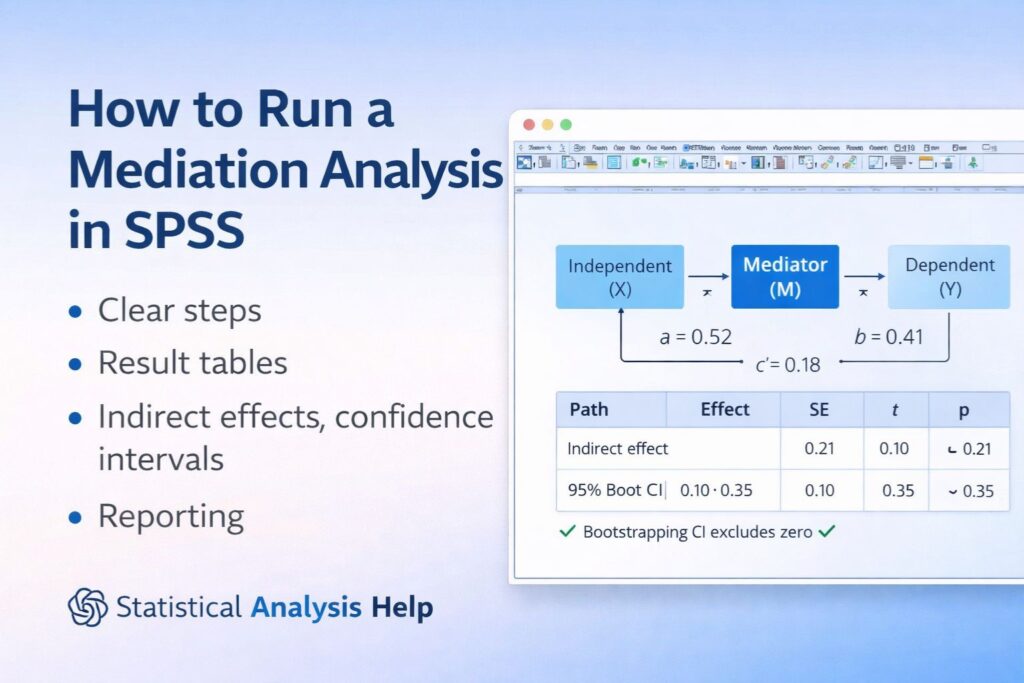
A mediation model tests whether the relationship between an independent variable and a dependent variable is transmitted through a mediator. Instead of stopping at the direct relationship, the analysis examines whether part of the effect moves through another variable.
The logic is usually described using three main paths.
| Path | Meaning |
|---|---|
| a | Effect of X on the mediator |
| b | Effect of the mediator on Y while controlling for X |
| c′ | Direct effect of X on Y after the mediator is included |
The indirect effect comes from the product of paths a and b. That indirect pathway is the center of the mediation question.
In simple terms, mediation analysis asks whether the effect of one variable on another is partly or fully explained by a third variable.
When Mediation Analysis Fits a Study
Mediation works best when the study has a clear theoretical reason for expecting a process or mechanism. It is most useful when the relationship between variables is expected to flow through an intermediate factor.
Common examples
| Independent variable | Mediator | Dependent variable |
|---|---|---|
| Training | Confidence | Performance |
| Social support | Stress reduction | Well-being |
| Service quality | Satisfaction | Loyalty |
| Study habits | Time management | Academic performance |
| Leadership style | Engagement | Productivity |
When the research question is really asking why or through what process an outcome occurs, mediation analysis can be a strong fit.
Why Mediation Analysis Feels Difficult in SPSS
Students often find mediation analysis confusing even after running the model. The difficulty usually starts with the output. It is not always obvious which table matters most, what the indirect effect means, or how to explain the findings clearly in academic language.
Common sources of confusion include:
| Common issue | Why it causes problems |
|---|---|
| Direct and indirect effects look similar | Students are unsure which one answers the mediation question |
| PROCESS output feels unfamiliar | The structure differs from standard regression output |
| Bootstrapping is misunderstood | The confidence interval is not always explained clearly |
| The model is significant but the write-up is weak | Output is not being translated into clear academic meaning |
| The mediator is significant but the indirect effect is unclear | Interpretation becomes inconsistent |
That is why mediation analysis should not end with running the model. The interpretation matters just as much as the software steps.
Main Ways to Run Mediation Analysis in SPSS
There are two common ways to approach mediation in SPSS.
Regression-based mediation
This approach uses a sequence of regression models to examine the paths one by one. It can be useful when the goal is to understand the structure of the model in more detail or when standard regression diagnostics are important to the assignment.
PROCESS macro mediation
Many students and researchers use Hayes’ PROCESS macro because it presents the direct effect, indirect effect, and bootstrap confidence intervals in one place. For simple mediation, the most common choice is Model 4.
For most coursework and dissertation work, PROCESS is often the cleaner route because it makes the indirect effect easier to read and easier to report.
Why the Indirect Effect Matters Most
In mediation analysis, the indirect effect is usually the main result. It shows whether the relationship between the independent variable and the dependent variable passes through the mediator.
The strongest evidence of mediation comes from the bootstrap confidence interval for the indirect effect.
| Result | Meaning |
|---|---|
| Confidence interval does not include zero | Indirect effect is significant |
| Confidence interval includes zero | Indirect effect is not significant |
This is one reason mediation analysis is often easier to interpret with bootstrapping. It gives a direct way to judge whether the mediated pathway is statistically meaningful.
Running the Model in SPSS
A clean mediation analysis usually starts with a clear model structure. The variables should already be prepared properly before the model is run.
| Role in model | Example |
|---|---|
| X | Training |
| M | Confidence |
| Y | Performance |
The data should be checked for coding problems, missing values, and any issues that might affect the regression-based paths. Once the variables are ready, the model can be estimated using either the standard regression route or the PROCESS macro.
In a simple mediation model, the software will estimate the path from X to M, the path from M to Y while controlling for X, the direct effect of X on Y, and the indirect effect through the mediator.
What to Read in the Output
A strong interpretation comes from reading the output in the right order. The most important pieces are the path coefficients, the direct effect, and the indirect effect.
Main results to focus on
| Output | What it shows |
|---|---|
| Path a | Whether X predicts the mediator |
| Path b | Whether the mediator predicts Y while controlling for X |
| Direct effect | Remaining effect of X on Y after including the mediator |
| Indirect effect | Effect transmitted through the mediator |
| Bootstrap confidence interval | Whether the indirect effect is significant |
A mediation result becomes much easier to explain when these pieces are treated as one connected story rather than several unrelated tables.
Example Results Table
Path coefficients
| Path | Effect | SE | t | p |
|---|---|---|---|---|
| X → M | 0.52 | 0.10 | 5.20 | < .001 |
| M → Y | 0.41 | 0.09 | 4.56 | < .001 |
| X → Y direct | 0.18 | 0.08 | 2.25 | .026 |
Indirect effect
| Indirect effect | Boot SE | 95% LLCI | 95% ULCI |
|---|---|---|---|
| 0.21 | 0.06 | 0.10 | 0.35 |
Interpretation of the example
The indirect effect is significant because the confidence interval ranges from 0.10 to 0.35 and does not include zero. This means the mediator carries part of the effect of the independent variable on the dependent variable. In this example, confidence mediates the relationship between training and performance.
Partial and Full Mediation
Mediation findings are often described as either partial or full.
| Pattern | Interpretation |
|---|---|
| Indirect effect significant and direct effect still significant | Partial mediation |
| Indirect effect significant and direct effect no longer significant | Full mediation |
This language can be useful, but it should still be connected to the theory of the study rather than treated as a label applied automatically.
Example Results Paragraph
A mediation analysis was conducted to examine whether confidence mediated the relationship between training and performance. Training significantly predicted confidence, b = 0.52, p < .001, and confidence significantly predicted performance while controlling for training, b = 0.41, p < .001. The direct effect of training on performance remained significant, b = 0.18, p = .026. The indirect effect was 0.21, and the 95% bootstrap confidence interval ranged from 0.10 to 0.35. Because the interval did not include zero, the indirect effect was significant. These findings indicate that confidence partially mediated the relationship between training and performance.
That style works much better than pasting software output into the chapter without explanation.
Dissertation-Style Summary Table
| Effect type | Effect | 95% CI | Interpretation |
|---|---|---|---|
| Total effect | 0.39 | 0.22 to 0.56 | Significant overall relationship |
| Direct effect | 0.18 | 0.02 to 0.34 | Significant direct pathway remains |
| Indirect effect | 0.21 | 0.10 to 0.35 | Significant mediated pathway |
This kind of summary table helps the findings look cleaner and makes the results easier to follow in a dissertation or thesis chapter.
Common Problems in Mediation Reporting
Many weak mediation write-ups come from the same mistakes.
One common problem is using mediation without a strong theoretical reason for the mediator. Another is paying attention only to the p-values for the individual paths while ignoring the indirect effect itself. Some students also confuse mediation with moderation, even though they answer different questions. Others paste PROCESS output into the chapter without turning the findings into readable academic interpretation.
Another issue appears when the model is run correctly but the results section sounds too mechanical. A strong mediation chapter should explain the process being tested, not only the software output.
Mediation vs Moderation
These two ideas are often confused, but they are not the same.
| Analysis type | Main question |
|---|---|
| Mediation | How or why does X affect Y? |
| Moderation | When or for whom does X affect Y? |
Mediation explains process. Moderation explains change in strength or direction across conditions or levels of another variable.
How Mediation Strengthens a Study
Mediation analysis can add depth to a study because it moves beyond simple association. It helps explain why a relationship exists and can make the findings more meaningful.
This is especially useful in projects involving behavior, attitudes, performance, health outcomes, learning, organizational processes, or psychological mechanisms. When the mediator is theoretically justified, the results often give the discussion chapter much more substance.
Clear Academic Reporting Matters
A mediation model can be technically correct and still lose strength if the reporting is weak. The results should read like a coherent explanation of the study, not like raw software output.
A strong mediation write-up usually includes:
| Reporting element | Purpose |
|---|---|
| Clear statement of the model | Shows what process is being tested |
| Path a result | Explains whether X predicts the mediator |
| Path b result | Explains whether the mediator predicts Y |
| Direct effect | Shows what remains after mediation is considered |
| Indirect effect | Answers the central mediation question |
| Confidence interval | Shows whether the indirect pathway is significant |
| Final conclusion | States whether mediation was supported |
If your results need stronger interpretation or clearer reporting, you can also visit how to interpret SPSS output, how to report regression results in APA format, and SPSS help for students. If you want direct help with your own mediation model, Request Quotes Now.
Final Thoughts
Learning how to run a mediation analysis in SPSS is really about understanding process. The software is only one part of it. What matters most is knowing how the variables relate, what the indirect effect means, and how to explain the findings clearly in a way that fits the study.
A strong mediation analysis helps show more than whether two variables are related. It helps explain why that relationship exists. When the model is well chosen and the results are well reported, the study becomes more informative, the results chapter becomes more convincing, and the discussion becomes easier to develop.
If your work involves mediation, PROCESS, regression paths, or dissertation-level reporting, you can also explore statistical analysis help, hypothesis testing help, and data analysis help. If you are ready to move forward, Request Quotes Now.
FAQ
What is mediation analysis in SPSS?
Mediation analysis in SPSS tests whether the effect of an independent variable on a dependent variable passes through a mediator.
What does the indirect effect mean?
The indirect effect shows how much of the relationship between X and Y is transmitted through the mediator.
How do I know if mediation is significant?
Mediation is usually treated as significant when the bootstrap confidence interval for the indirect effect does not include zero.
What is the difference between direct and indirect effects?
The direct effect is the remaining relationship between X and Y after the mediator is included. The indirect effect is the part that passes through the mediator.
What is partial mediation?
Partial mediation means the indirect effect is significant, but the direct effect remains significant as well.
What is full mediation?
Full mediation means the indirect effect is significant and the direct effect is no longer significant after the mediator is included.
Can mediation be done without the PROCESS macro?
Yes. It can also be examined through a sequence of regression models, although many students prefer PROCESS because the output is easier to read.
Is mediation the same as moderation?
No. Mediation explains how an effect happens, while moderation examines whether the effect changes across levels of another variable.
Is mediation analysis common in dissertations?
Yes. It is widely used in dissertation and thesis work where the study aims to explain mechanisms or pathways between variables.
How should mediation results be reported?
A strong report should include the path coefficients, the direct effect, the indirect effect, the confidence interval, and a clear conclusion about whether mediation was supported.