
How to Reverse Code in SPSS
Reverse coding is one of the most important steps in questionnaire and survey data preparation. Many research instruments include both positively worded and negatively worded items. If the negatively worded items are not reversed before analysis, the scale score can become incorrect, reliability can become weak, and the final interpretation can be misleading.
This is why learning how to reverse code in SPSS matters for students, researchers, dissertation writers, and anyone working with Likert scale data. A survey may look clean at first, but if one or two items point in the opposite direction, the results may not reflect the construct properly. This is especially important before creating composite scores, running Cronbach’s alpha, interpreting correlations, or using regression analysis.
Reverse coding is usually done through the Transform menu in SPSS, most often by using Recode into Different Variables. Kent State University’s SPSS tutorial explains that recoding can be used to change or merge categories for both string and numeric variables, while Laerd Statistics shows how transformation tools in SPSS can be used to create changed versions of existing variables.
If your questionnaire has reverse-worded items and you are not sure whether they have been coded correctly, Request Quote Now.
What Does Reverse Coding Mean in SPSS?
Reverse coding means changing the direction of a variable’s values so that all items in a scale point the same way. It is commonly used with Likert scale items where some questions are worded positively and others are worded negatively.
For example, suppose a satisfaction scale uses values from 1 to 5, where 1 means strongly disagree and 5 means strongly agree. A positive item might say, “I am satisfied with the service.” A negative item might say, “I am unhappy with the service.” If both items are used in the same satisfaction scale, the negative item must be reversed so that higher values consistently represent higher satisfaction.
Without reverse coding, SPSS may treat agreement with a negative statement as if it means the same thing as agreement with a positive statement. That can damage the final scale score and produce weak or confusing results.
Reverse coding is closely connected with How to Analyze Likert Scale Data because many questionnaire datasets need this step before analysis.
Why Reverse Coding Is Important
Reverse coding protects the meaning of a scale. Many questionnaires include negatively worded items to reduce response bias, encourage careful reading, or balance the instrument. These items are useful, but only when they are coded properly before analysis.
If reverse coding is skipped, the items in the same scale may pull in opposite directions. This can reduce Cronbach’s alpha, weaken correlations, affect regression results, and make composite scores misleading. A student may think a scale is unreliable when the real problem is that one or more items were not reversed.
In dissertation and thesis work, this can affect Chapter 4 directly. A reliability table may look weak, a correlation may appear lower than expected, or a regression model may become difficult to explain. Correct reverse coding helps ensure that the analysis reflects the real construct being measured.
Table 1. Why Reverse Coding Matters
| Problem if not reversed | Possible effect on results | Why it matters |
|---|---|---|
| Negative item points opposite way | Low Cronbach’s alpha | Scale may appear unreliable |
| Composite score includes wrong direction | Misleading total or mean score | Interpretation becomes incorrect |
| Correlation becomes weaker | Relationships look smaller | Hypotheses may appear unsupported |
| Regression coefficient changes | Predictor effect may be distorted | Model interpretation becomes weak |
| Group comparison becomes unclear | Mean differences may be misleading | Results may not match the construct |
When Should You Reverse Code in SPSS?
You should reverse code when a survey item is worded in the opposite direction from the other items in the same scale. This is most common in Likert scale questionnaires.
For example, in a motivation scale, most items may be positive, such as “I feel motivated to complete my studies.” A reverse-worded item may say, “I often feel like giving up on my studies.” If higher scores are intended to represent higher motivation, agreement with the negative item should not increase the motivation score. It must be reversed.
Reverse coding is also needed when the scoring manual for a questionnaire tells you that certain items must be reversed before calculating the total score. Always check the instrument instructions, questionnaire source, or research design before creating final scale scores.
Table 2. Examples of Items That May Need Reverse Coding
| Scale | Positive item | Reverse-worded item |
|---|---|---|
| Satisfaction | I am satisfied with the service | I am unhappy with the service |
| Motivation | I feel motivated to study | I often feel like giving up |
| Self-confidence | I feel confident in my ability | I doubt my ability to succeed |
| Job engagement | I feel engaged at work | I feel disconnected from my work |
| Trust | I trust the organization | I do not trust the organization |
Reverse Coding Formula for Likert Scale Items
The reverse coding formula depends on the scale range. For a 1–5 scale, the reversed score is calculated as:
New score = 6 − original score
For a 1–7 scale:
New score = 8 − original score
For a 0–10 scale:
New score = 10 − original score
A simple rule is:
New score = highest value + lowest value − original score
Table 3. Reverse Coding for a 1–5 Likert Scale
| Original value | Reversed value |
|---|---|
| 1 | 5 |
| 2 | 4 |
| 3 | 3 |
| 4 | 2 |
| 5 | 1 |
Table 4. Reverse Coding for a 1–7 Likert Scale
| Original value | Reversed value |
|---|---|
| 1 | 7 |
| 2 | 6 |
| 3 | 5 |
| 4 | 4 |
| 5 | 3 |
| 6 | 2 |
| 7 | 1 |
These tables are useful because many reverse coding mistakes happen when researchers forget the middle value stays the same.
How to Reverse Code in SPSS Using Recode into Different Variables
The safest way to reverse code in SPSS is to use Recode into Different Variables. This keeps the original item unchanged and creates a new reversed version. Keeping the original variable is important because it allows you to check your work and correct mistakes later.
To reverse code a 1–5 Likert item, go to Transform → Recode into Different Variables. Move the item into the input box, give the new variable a clear name, and define each old value and new value. For example, 1 becomes 5, 2 becomes 4, 3 stays 3, 4 becomes 2, and 5 becomes 1.
Hospitality Institute’s SPSS transformation discussion includes recoding as one of the key data transformation techniques, while IBM Community discussions show that users often need to review or trace transformations and formulas after creating variables.
Table 5. Reverse Coding Steps in SPSS
| Step | SPSS action | Expected result |
|---|---|---|
| 1 | Go to Transform → Recode into Different Variables | Recode dialog opens |
| 2 | Select the item to reverse code | Original variable is selected |
| 3 | Enter a new output variable name | New reversed variable is created |
| 4 | Click Old and New Values | Recoding rules can be entered |
| 5 | Define the reverse coding rules | SPSS knows how to reverse the values |
| 6 | Click Continue, then OK | Reversed item appears in Data View |
| 7 | Run Frequencies | Confirms the values were reversed correctly |
Naming Reverse-Coded Variables Clearly
Good variable naming matters because SPSS output can become confusing when a dataset contains many items. A reverse-coded item should have a clear name that shows it is the reversed version of the original item.
For example, if the original item is Q4, the reversed version could be named Q4_R. If the original item is stress3, the reversed item could be named stress3_R. The label should also explain what happened, such as “Stress item 3 reverse coded.”
Table 6. Clear Naming Examples
| Original variable | Reverse-coded variable | Variable label |
|---|---|---|
| Q4 | Q4_R | Q4 reverse coded |
| stress3 | stress3_R | Stress item 3 reverse coded |
| trust_neg2 | trust_neg2_R | Trust negative item 2 reversed |
| mot5 | mot5_R | Motivation item 5 reverse coded |
| sat_neg1 | sat_neg1_R | Satisfaction negative item reversed |
Clear names help when creating composite scores, running reliability analysis, and writing the results section.
How to Check Whether Reverse Coding Worked
After reverse coding, always check the result. Do not assume that the recode worked correctly just because SPSS created a new variable.
A good check is to run frequencies for both the original and reversed item. The distribution should be flipped. If many respondents had a 1 in the original variable, those cases should now have a 5 in the reversed variable. A crosstab between the original item and the reversed item can also confirm whether the mapping is correct.
Table 7. Checking Reverse Coding Results
| Check | What to look for | Why it matters |
|---|---|---|
| Frequencies | Values appear in the expected range | Confirms no invalid values were created |
| Crosstabs | Old and new values match the reverse rule | Confirms correct mapping |
| Descriptives | Mean changes in expected direction | Helps detect unusual results |
| Missing values | Missing codes remain missing | Prevents accidental recoding of missing data |
| Reliability analysis | Cronbach’s alpha improves or makes sense | Confirms item direction is aligned |
This step is important because one wrong old/new value rule can affect every analysis that uses the scale.
Handling Missing Values During Reverse Coding
Missing values need special care during reverse coding. If missing responses are coded as 99, 999, or another placeholder, they should not be converted into a valid scale value. For example, in a 1–5 Likert scale, a missing value of 99 should not become 1, 2, 3, 4, or 5.
Before reverse coding, define user-missing values in Variable View or handle them clearly during the recoding process. This protects the final scale score from including fake valid responses.
Table 8. Missing Value Example
| Original value | Meaning | Correct action |
|---|---|---|
| 1 | Strongly disagree | Recode to 5 |
| 2 | Disagree | Recode to 4 |
| 3 | Neutral | Keep as 3 |
| 4 | Agree | Recode to 2 |
| 5 | Strongly agree | Recode to 1 |
| 99 | Missing response | Keep as missing |
If your dataset has missing values, how to clean data in SPSS can support the preparation stage before reverse coding.
Reverse Coding Before Creating Composite Scores
Reverse coding should happen before composite scores are created. A composite score combines several items into one total or mean score. If a negative item is not reversed first, the composite score will mix opposite meanings.
For example, if higher scores represent higher satisfaction, every item in the satisfaction scale must point in that direction before calculating the mean. Once reverse-coded items are corrected, SPSS can compute the final score using the Compute Variable function.
Table 9. Correct Composite Score Workflow
| Step | Action | Why it matters |
|---|---|---|
| 1 | Identify positive and negative items | Confirms which items need reversal |
| 2 | Reverse-code negative items | Aligns item direction |
| 3 | Check recoded items | Confirms correct values |
| 4 | Run reliability analysis | Tests internal consistency |
| 5 | Compute mean or total score | Creates final analysis variable |
| 6 | Check descriptive statistics | Confirms the score is reasonable |
This workflow is especially important in dissertations, theses, and survey-based assignments.
Reverse Coding and Cronbach’s Alpha
Cronbach’s alpha is commonly used to assess whether items in a scale are internally consistent. Reverse coding can strongly affect alpha because items that point in the wrong direction reduce consistency.
If alpha is unexpectedly low, one possible reason is that a reverse-worded item was not reversed correctly. After reverse coding, the item-total statistics and Cronbach’s alpha should be reviewed again. In some cases, alpha improves when the reverse-coded item is aligned properly.
This is why reverse coding should always be checked before reliability interpretation. For deeper support, see how to interpret SPSS output.
Table 10. Reverse Coding and Reliability
| Situation | Possible alpha result | Meaning |
|---|---|---|
| Negative item not reversed | Low alpha | Items may be pointing in opposite directions |
| Negative item reversed correctly | Alpha improves | Scale direction is aligned |
| Item still weak after reversal | Alpha may remain low | Item may not fit the scale |
| Missing values mishandled | Alpha may be distorted | Data preparation needs review |
Reverse Coding vs Recoding Variables in SPSS
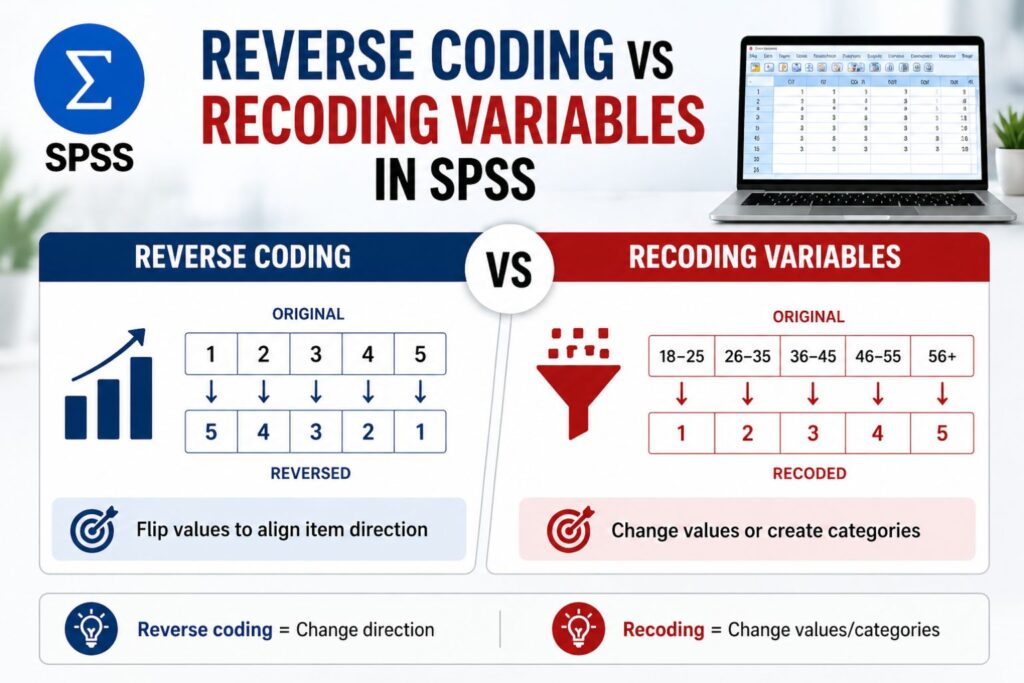
Reverse coding is one specific form of recoding. In general, recoding means changing old values into new values, such as grouping ages or converting categories into numeric codes. With reverse coding, the purpose is narrower: the values are changed so the direction of a scale is reversed.
For example, grouping age into categories is recoding, but it is not reverse coding. Changing 1 to 5, 2 to 4, 4 to 2, and 5 to 1 on a Likert item is reverse coding.
Table 11. Reverse Coding vs General Recoding
| Feature | Reverse coding | General recoding |
|---|---|---|
| Main purpose | Change direction of a scale | Change or group values |
| Common use | Negative Likert items | Age groups, categories, missing codes |
| Example | 1 becomes 5 on a 1–5 scale | 18–25 becomes age group 1 |
| Most common tool | Recode into Different Variables | Recode into Different Variables |
| Main risk | Wrong scale direction | Wrong grouping or category mapping |
For broader recoding tasks, visit how to recode variables in SPSS.
Reverse Coding vs Transforming Variables in SPSS
Reverse coding is also part of variable transformation. Transforming variables can include computing new variables, applying formulas, grouping values, converting string variables, or changing skewed variables. Reverse coding is focused specifically on changing item direction.
Table 12. Reverse Coding vs Variable Transformation
| Area | Reverse coding | Variable transformation |
|---|---|---|
| Purpose | Align item direction | Prepare variables for analysis |
| Example | Reverse negative Likert item | Compute total score |
| Output | Reverse-coded item | New or modified variable |
| Common menu | Transform → Recode | Transform menu |
| Research use | Scale and questionnaire scoring | Wider data preparation |
For wider preparation tasks, see how to transform variables in SPSS.
Common Mistakes When Reverse Coding in SPSS
A common mistake is recoding into the same variable and losing the original data. This can make it difficult to check the transformation later. Another mistake is forgetting that the middle value stays the same on odd-numbered scales. For example, on a 1–5 scale, 3 remains 3.
Some students also reverse-code items that should not be reversed. This can happen when they assume every negative-sounding item needs reversal without checking the scoring guide. Others forget to handle missing values and accidentally treat missing codes as real responses.
A strong reverse coding process should be careful, documented, and checked before analysis.
Table 13. Reverse Coding Mistakes and Fixes
| Mistake | Why it is a problem | Better approach |
|---|---|---|
| Recoding into same variable | Original data is lost | Recode into different variable |
| Reversing the wrong item | Scale meaning becomes distorted | Check questionnaire scoring guide |
| Mishandling missing values | Missing values become real scores | Define missing values first |
| Forgetting middle value | Recode rule becomes wrong | Keep middle value unchanged |
| Not checking results | Hidden errors remain | Run frequencies or crosstabs |
Example: Before and After Reverse Coding
Imagine a 1–5 satisfaction scale where higher scores should mean higher satisfaction. The item “I am unhappy with the service” must be reversed. If a respondent selects 5, that means they strongly agree they are unhappy, so the reversed score should be 1.
Table 14. Before and After Reverse Coding Example
| Respondent | Original negative item | Meaning before reversal | Reversed score | Meaning after reversal |
|---|---|---|---|---|
| 1 | 5 | Very unhappy | 1 | Low satisfaction |
| 2 | 4 | Somewhat unhappy | 2 | Lower satisfaction |
| 3 | 3 | Neutral | 3 | Neutral |
| 4 | 2 | Not very unhappy | 4 | Higher satisfaction |
| 5 | 1 | Not unhappy | 5 | High satisfaction |
This example shows why reverse coding is necessary before creating the final scale score.
How Reverse Coding Helps Dissertation and Research Results
Reverse coding improves the quality of dissertation and research results because it ensures that scale items measure the construct in the same direction. This helps produce more meaningful reliability results, more accurate composite scores, and clearer interpretation.
In Chapter 4, reverse coding may not always need a long explanation, but the results depend on it. If negatively worded items were part of the questionnaire, they should be handled before reliability analysis and before computing scale scores.
This connects naturally with SPSS analysis help, dissertation data analysis help, and data analysis help.
Get Expert Help With Reverse Coding in SPSS
Reverse coding looks simple, but small mistakes can affect reliability, composite scores, correlations, regression, and final interpretation. This is especially true when a questionnaire has many items, several reverse-worded statements, missing value codes, and multiple scales.
Expert support can help identify which items need reverse coding, apply the correct SPSS recode rules, check the results, run reliability analysis, create composite scores, and prepare the dataset for final analysis.
If you want your SPSS questionnaire data prepared correctly, Request Quote Now.
Why Choose Statistical Analysis Help
Statistical Analysis Help supports students, researchers, and professionals who need accurate SPSS data preparation and results interpretation. Reverse coding is treated as part of the full analysis workflow, not as an isolated software step.
Support can include reverse coding, variable transformation, Likert scale preparation, reliability testing, descriptive statistics, hypothesis testing, regression analysis, and full dissertation results support. The goal is to help you work with data that is clean, correctly coded, and ready for accurate interpretation.
Good reverse coding gives your analysis a stronger foundation. It makes reliability results more meaningful, composite scores more accurate, and final findings easier to defend.
FAQ: How to Reverse Code in SPSS
What does reverse coding mean in SPSS?
Reverse coding means changing the direction of a variable’s values so that all items in a scale point the same way. It is often used for negatively worded Likert scale items.
When should I reverse code a variable?
You should reverse code a variable when it is worded in the opposite direction from other items in the same scale and the scoring guide requires it.
How do I reverse code a 1–5 Likert scale in SPSS?
Use Recode into Different Variables and set 1 = 5, 2 = 4, 3 = 3, 4 = 2, and 5 = 1.
Should I recode into the same variable or a different variable?
Recoding into a different variable is safer because it keeps the original item unchanged and allows you to check the transformation later.
Does reverse coding affect Cronbach’s alpha?
Yes. If a negative item is not reversed, Cronbach’s alpha may become low because the item points in the opposite direction from the rest of the scale.
Can missing values affect reverse coding?
Yes. Missing values such as 99 or 999 should not be recoded as valid scale values. They should remain missing.
How do I check whether reverse coding worked?
Run frequencies or crosstabs comparing the original and reverse-coded item. The values should follow the correct reverse mapping.
Is reverse coding the same as recoding?
Reverse coding is a type of recoding. Recoding changes values generally, while reverse coding specifically reverses the direction of a scale.
Should I reverse code before creating a composite score?
Yes. Reverse-code negative items first, then check reliability, and then create the final mean or total score.
Can you help reverse code my SPSS data?
Yes. Statistical Analysis Help can support reverse coding, reliability analysis, composite score creation, and full SPSS data preparation.
Final Call to Action
Reverse coding is a small step with a big effect on questionnaire analysis. If reverse-worded items are not handled correctly, reliability, composite scores, correlations, regression, and interpretation can all be affected.
If you need help reverse coding variables in SPSS, preparing Likert scale data, checking reliability, or creating accurate scale scores, get expert support today.