
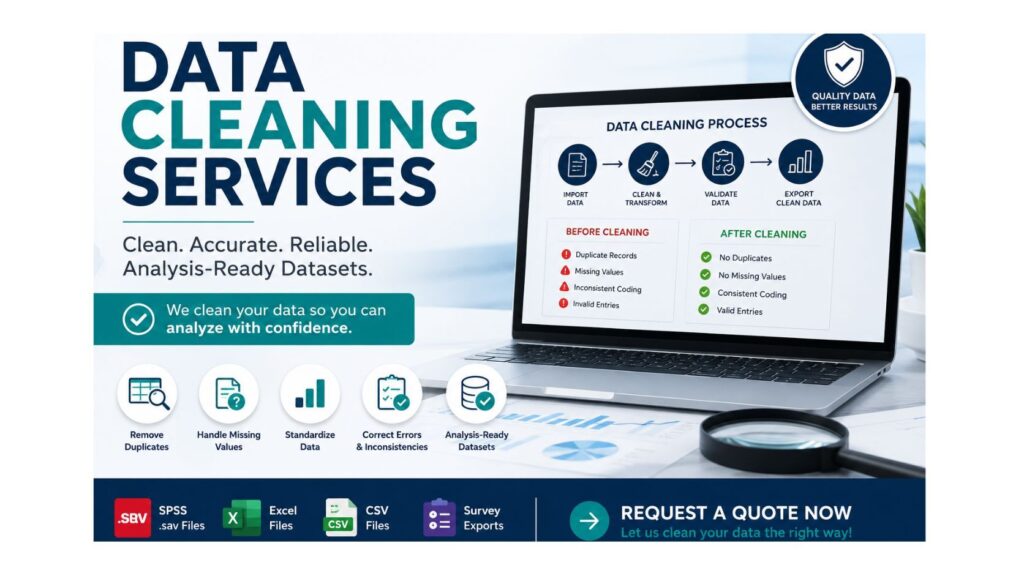
Data Cleaning Services help you fix messy datasets before statistical analysis, reporting, dissertation results, survey analysis, business dashboards, or research interpretation. A dataset may look complete at first glance, but hidden problems such as missing values, duplicate records, inconsistent coding, unclear variable labels, invalid entries, outliers, messy Excel formatting, survey export errors, SPSS formatting issues, and unmatched IDs can affect every result that follows.
Dirty data can make the correct statistical test produce unreliable results. If Likert scale responses are coded inconsistently, duplicate participants remain in the file, missing values are not handled correctly, or ID variables do not match across files, the final output may be misleading. In many cases, the problem is not the analysis method. The real issue is that the dataset was not cleaned before analysis began.
Data cleaning is the preparation stage before analysis. It helps make your dataset accurate, organized, consistent, and ready for descriptive statistics, hypothesis testing, regression analysis, survey reporting, dissertation results, business reports, dashboards, and statistical modeling.
StatisticalAnalysisHelp.com provides data cleaning support for students, dissertation researchers, thesis writers, survey researchers, business analysts, healthcare researchers, public health researchers, social science researchers, market researchers, and professionals who need clean, analysis-ready datasets.
Need Data Cleaning Services? Request a Quote Now
Send your SPSS files, Excel files, CSV files, survey exports, questionnaire data, research datasets, business datasets, supervisor comments, data dictionaries, codebooks, or analysis instructions. StatisticalAnalysisHelp.com can help identify data problems, clean variables, fix coding issues, review missing values, detect duplicates, standardize labels, prepare ID variables, and structure your dataset for later analysis.
Request a Quote Now if you want your dataset cleaned, checked, structured, and prepared for analysis.
Quick Answer: What Are Data Cleaning Services?
Data cleaning services are professional support services that identify, correct, standardize, validate, and prepare messy datasets before analysis. The goal is to make the dataset accurate, consistent, readable, and ready for statistical or business use.
Data cleaning does not mean changing results dishonestly. It means fixing data-quality problems that can interfere with valid analysis.
| Data Problem | What It Means | Cleaning Action |
|---|---|---|
| Missing values | Blank or incomplete responses | Review, code, flag, document, or prepare for proper handling |
| Duplicate records | The same case appears more than once | Identify, verify, remove, retain, or document based on the data structure |
| Inconsistent coding | The same category is coded differently | Standardize codes, labels, and response categories |
| Wrong data type | Numbers stored as text or IDs stored incorrectly | Convert and format variables correctly |
| Invalid values | Values fall outside the allowed range | Detect, verify, correct, flag, or document |
| Messy IDs | IDs are missing, repeated, or formatted differently | Clean IDs for matching, merging, and analysis |
| Poor labels | Variables or values are unclear | Rename, label, and document variables clearly |
The final goal is a clean dataset that can be understood, checked, and used confidently for the next step.
If your dataset has missing values, duplicates, inconsistent labels, or formatting errors, Request a Quote Now for data cleaning support.
Data Cleaning Services vs Data Analysis Help
Data cleaning and data analysis are related, but they are not the same service. This page focuses on preparing messy datasets before analysis. It should not be confused with a full statistical analysis service.
| Service | Main Purpose | Best For |
|---|---|---|
| Data Cleaning Services | Prepare messy data before analysis | Missing values, duplicates, coding, labels, formatting, invalid entries |
| Data Analysis Help | Analyze cleaned data and interpret results | Statistical tests, models, output interpretation, report writing |
| SPSS Data Analysis Help | Run and interpret SPSS analysis | SPSS output, tests, tables, and results |
| Survey Data Analysis Help | Analyze survey or questionnaire responses | Scale scores, frequencies, cross-tabs, and survey results |
Many clients need data cleaning first and analysis second. For example, a dissertation student may have a survey dataset with missing responses, duplicate submissions, unclear labels, and inconsistent Likert coding. That dataset should be cleaned before hypothesis testing, regression analysis, factor analysis, or formal results writing begins.
This distinction matters because clean data protects the quality of the analysis that follows. Without cleaning, even advanced statistical methods can produce weak or inaccurate results. If you need analysis after your dataset is cleaned, see our Data Analysis Help service.
Who Needs Data Cleaning Services?
You may need data cleaning services if your dataset is not ready for analysis. This is common when data comes from survey platforms, Excel files, manual entry, multiple sources, SPSS exports, business systems, or combined datasets.
Data cleaning support is useful for dissertation students preparing Chapter 4 results, thesis writers working with survey or experimental data, researchers with questionnaire datasets, survey researchers cleaning exported responses, business analysts preparing reports or dashboards, healthcare researchers reviewing patient or clinical datasets, public health researchers preparing field or survey data, social science researchers working with coded responses, and market researchers cleaning customer or survey data.
It is also useful for SPSS, R, Stata, Python, and Excel users who need structured datasets before analysis. Clients with supervisor feedback about data quality often need cleaning before rerunning statistics or rewriting results.
Even when your research questions are clear, the dataset may still need cleaning before valid analysis can begin.
If you are unsure whether your file is ready for analysis, Request a Quote Now for a dataset review.
Common Data Problems We Clean
Messy data appears in many forms. Some problems are obvious, such as blank cells or duplicate rows. Others are hidden, such as inconsistent value labels, wrong variable types, invalid dates, out-of-range values, or IDs that fail to match across files.
Missing Values
Missing values are one of the most common dataset problems. They may appear as blank cells, system-missing values, user-defined missing codes, skipped survey items, incomplete cases, missing demographic responses, or unanswered questionnaire sections.
Missing values must be reviewed carefully. Removing every incomplete case may reduce sample size and weaken the analysis. Ignoring missing values may also distort results. The right approach depends on the research design, variable type, amount of missingness, and analysis plan.
Data cleaning can help identify where missing values occur, how they are coded, whether missingness affects key variables, and how the dataset should be prepared for later analysis.
Duplicate Records
Duplicate records occur when the same participant, respondent, customer, patient, case, transaction, or observation appears more than once. Duplicates may come from repeated survey submissions, copied rows, system exports, merged files, or data entry errors.
Not every repeated record is wrong. Some repeated records are valid, such as repeated measurements, multiple clinic visits, multiple purchases, or time-point observations. Data cleaning reviews duplicates before deciding whether they should be removed, retained, flagged, or restructured.
Inconsistent Coding
Inconsistent coding happens when the same response category is coded in different ways. For example, one part of the file may use Male/Female, another may use M/F, and another may use 1/2. A yes/no item may be coded as Yes/No in one variable and 1/0 in another.
Likert scale coding can also create problems. Some items may be coded from 1 to 5, while reverse-worded items may need careful treatment. If reverse-coded items are not handled correctly, scale scores and reliability analysis can be wrong.
Data cleaning standardizes coding so the dataset is consistent and ready for analysis.
Wrong Variable Types
Wrong variable types can create serious analysis problems. A numeric variable may be stored as text. An ID variable may lose leading zeros. Dates may import incorrectly. Percentages, currency fields, or long text responses may appear in formats that statistical software cannot use properly.
For example, an Excel file may store participant ID 00145 as 145. If another file uses 00145, the two records may not match during merging. Cleaning variable types before analysis prevents these avoidable errors.
Invalid or Out-of-Range Values
Invalid values are entries that do not make sense for the variable. Examples include age values outside possible ranges, Likert responses outside the scale limits, impossible dates, negative values where only positive values are allowed, and total scores that do not match item values.
These values should be detected and reviewed before analysis. Some may be data entry errors. Others may need to be flagged or documented. The cleaning process helps ensure that unusual values are handled transparently.
Poor Variable Names and Labels
Many datasets come with unclear variable names such as Q1, Q2, VAR0001, Response_45, or long survey export names. These can make analysis confusing, especially when preparing SPSS output, dissertation tables, or research reports.
Data cleaning can improve variable names, variable labels, and value labels so the dataset becomes easier to understand. Clear labeling also reduces errors during analysis and reporting.
Messy Survey Exports
Survey platforms often export extra metadata, incomplete responses, timestamps, progress scores, skipped items, duplicate submissions, attention-check fields, and long text variables. These files may also include logic-skip patterns that must be understood before cleaning.
Survey data cleaning may involve removing unnecessary export columns, reviewing incomplete responses, checking attention-check items, cleaning Likert scale variables, preparing open-ended response fields, and organizing scale items for later analysis.
Outliers and Unusual Values
Outliers are values that are unusually high or low compared with the rest of the data. They may be genuine observations, data entry errors, measurement errors, or special cases.
Outliers should not be deleted automatically. A responsible cleaning process detects outliers, reviews them, checks whether they are plausible, and documents how they were handled. The final decision depends on the research design, measurement scale, and analysis plan.
Data Merging and ID Problems
ID variables are essential when combining files. Problems occur when IDs are missing, duplicated, formatted differently, or imported incorrectly. Leading zeros, extra spaces, mixed numeric and string formats, and inconsistent naming can prevent records from matching correctly.
Data cleaning can prepare IDs before merging and reduce the risk of unmatched records, duplicate cases, or incorrect joins.
Our Data Cleaning Process
A strong data cleaning process is systematic. It should not be random, rushed, or based only on visual inspection. StatisticalAnalysisHelp.com follows a practical workflow designed to prepare datasets for later statistical analysis or reporting.
File Review and Project Scope
The process begins by reviewing the file type, research purpose, known data problems, and required output format. This step helps determine whether the dataset needs simple cleanup, SPSS preparation, survey cleaning, missing-value review, duplicate checking, or more detailed restructuring.
You may provide a dataset, codebook, data dictionary, questionnaire, supervisor comments, project instructions, or analysis plan.
Data Structure Inspection
The dataset structure is reviewed to understand rows, columns, variables, cases, IDs, response patterns, and file layout. This step helps identify whether each row represents a participant, response, visit, transaction, time point, organization, or another unit.
Good structure matters because the dataset must match the planned analysis.
Variable and Label Review
Variable names, variable labels, and value labels are checked for clarity and consistency. Unclear names can be improved, duplicate names can be resolved, and labels can be aligned with the questionnaire or codebook.
This is especially important in SPSS because Variable View controls how output is displayed and interpreted.
Missing Value Check
Missing values are identified and reviewed. This includes blank cells, system-missing values, user-defined missing codes, skipped responses, incomplete cases, and unusual missing-value codes such as 99, 999, or -1.
The cleaning process prepares missing values so they can be handled properly during analysis.
Duplicate Record Check
Duplicate cases, duplicate IDs, repeated submissions, and repeated rows are checked. Where duplicates are found, they are reviewed based on the dataset structure. Some duplicates may be removed, while valid repeated records may need to be retained and documented.
Coding Consistency Review
Response categories are reviewed for consistency. This includes yes/no coding, gender categories, Likert responses, reverse-coded items, group labels, scale values, and categorical variables.
Consistent coding helps prevent inaccurate frequencies, cross-tabulations, reliability results, and statistical tests.
Data Type and Format Correction
Data types are reviewed and corrected where necessary. Numeric variables should be numeric, text variables should be correctly formatted, dates should be readable, and ID variables should retain the correct format.
This step is especially important when files come from Excel, CSV, survey platforms, or manual data entry.
ID and Merge-Readiness Check
If your dataset needs to be merged with another file, ID variables are checked for missing values, duplicates, leading zeros, spaces, and inconsistent formatting.
Clean IDs make file matching more reliable.
Outlier and Range Screening
Variables are reviewed for unusual, invalid, or out-of-range values. This may include impossible ages, invalid scale values, extreme scores, impossible dates, or totals that do not match item responses.
The purpose is to identify issues before analysis, not to remove values without reason.
Cleaned Dataset Preparation
After the data-quality problems are addressed, a cleaned dataset is prepared in the required format. This may be SPSS, Excel, CSV, R, Stata, or another agreed format.
The final file should be easier to analyze, interpret, and report.
Documentation of Changes
Where appropriate, cleaning decisions can be documented. This may include notes about missing values, duplicate records, recoded variables, removed columns, corrected formats, or prepared ID variables.
Documentation is especially useful for dissertation, thesis, research, and team-based projects.
Optional Next-Step Readiness Check
Data cleaning comes before analysis. After the dataset is clean, it can be checked for readiness based on the intended next step, such as descriptive summaries, regression, survey analysis, factor analysis, reporting, or dashboard preparation.
Request a Quote Now for a cleaned, checked, and analysis-ready dataset.
Data Cleaning for SPSS Files
SPSS data cleaning requires careful attention to both Data View and Variable View. A file may look fine in Data View but still contain incorrect labels, missing-value settings, wrong variable types, or inconsistent coding in Variable View.
SPSS data cleaning may include:
- Variable View cleanup.
- Data View review.
- Variable-name correction.
- Variable-label review.
- Value-label setup.
- Missing-value code review.
- Numeric versus string variable checks.
- Recode preparation.
- Compute variable preparation.
- Duplicate case detection.
- ID variable cleaning.
- Merge preparation.
- Syntax documentation.
- Preparing files for SPSS analysis.
This is useful when you plan to run frequencies, descriptives, cross-tabs, t-tests, ANOVA, correlation, regression, factor analysis, reliability analysis, or other SPSS procedures.
Request a Quote Now for SPSS data cleaning before analysis.
Data Cleaning for Excel and CSV Files
Many datasets begin in Excel or CSV format before they are imported into SPSS, R, Stata, Python, Power BI, Tableau, or another tool. These files often need cleaning because spreadsheet formats can create hidden data-quality problems.
Excel and CSV cleaning may involve:
- Fixing header row problems.
- Removing blank columns and extra rows.
- Handling merged cells.
- Standardizing date formats.
- Removing formulas from data ranges where needed.
- Checking hidden rows or filters.
- Preserving leading zeros in IDs.
- Separating mixed text and numeric values.
- Detecting duplicate rows.
- Standardizing inconsistent categories.
- Preparing files for import into statistical software.
Excel files are especially prone to formatting issues. A column may look numeric but contain text values. Dates may change format. IDs may lose zeros. A column may include both numbers and words. These issues should be fixed before importing the file into statistical software.
Survey Data Cleaning Services
Survey data often needs cleaning before meaningful analysis can begin. A survey export may contain incomplete responses, duplicate submissions, skipped items, hidden metadata, attention-check failures, or inconsistent scale coding.
Survey data cleaning can include:
- Reviewing incomplete responses.
- Checking duplicate submissions.
- Identifying straight-lining patterns.
- Reviewing attention-check failures.
- Understanding logic-skip errors.
- Detecting invalid responses.
- Preparing open-ended response fields.
- Reviewing scale items.
- Checking reverse-coded items.
- Cleaning Likert scale variables.
- Reviewing missing survey items.
- Removing unnecessary exported metadata.
- Preparing survey data for analysis.
Cleaned survey data can later be used for descriptive statistics, cross-tabulation, regression, factor analysis, reliability analysis, hypothesis testing, and report writing.
Research and Dissertation Data Cleaning Services
Dissertation and thesis datasets often need cleaning before Chapter 4 analysis can begin. A student may have collected questionnaire data, imported survey responses, combined multiple files, or received supervisor feedback that the dataset needs correction.
Research and dissertation data cleaning may include:
- Dissertation dataset review.
- Thesis dataset cleanup.
- Chapter 4 preparation.
- Supervisor-comment review.
- Research questionnaire cleaning.
- Codebook alignment.
- Identifying and removing unnecessary identifiers where appropriate.
- Preparing analysis-ready SPSS, Excel, CSV, R, or Stata files.
- Cleaning data before hypothesis testing or regression.
- Documenting cleaning decisions.
A clean dataset helps prevent problems later in the results chapter. It also makes it easier to explain how the data were prepared before statistical testing.
Business Data Cleaning Services
Business datasets often come from CRM systems, sales exports, operational records, customer lists, inventory systems, dashboards, and reporting tools. These files may contain duplicate customers, inconsistent product names, missing contact fields, date-format problems, incorrect currency fields, or repeated transactions.
Business data cleaning can help prepare:
- Customer records.
- Sales data.
- CRM exports.
- Transaction data.
- Operational data.
- Inventory data.
- KPI reports.
- Dashboard source files.
- Product and service lists.
- Contact datasets.
- Monthly or quarterly reports.
A clean business dataset is easier to summarize, visualize, and use for decision-making. Data cleaning can prepare files for Excel reports, Power BI dashboards, Tableau dashboards, and business presentations.
What We Clean
StatisticalAnalysisHelp.com can help clean different types of datasets, depending on the file condition and project goal.
Common files and datasets include:
- SPSS .sav files.
- Excel files.
- CSV files.
- Survey exports.
- Questionnaire datasets.
- Dissertation datasets.
- Thesis datasets.
- Business datasets.
- Healthcare datasets.
- Public health datasets.
- Market research data.
- Customer data.
- Experimental data.
- Pre-test and post-test datasets.
- Panel or repeated-measures data where the structure is clear.
- Files prepared for SPSS, Excel, R, Stata, Python, Power BI, or Tableau.
What We Do Not Do
Trust matters in data cleaning. The purpose of cleaning is to improve data quality, not to distort the truth.
StatisticalAnalysisHelp.com does not fabricate data, manipulate results, change responses dishonestly, or alter data to force statistical significance. Cleaning decisions should preserve the meaning of the original data and support transparent analysis.
The service also does not promise guaranteed grades, guaranteed approval, guaranteed publication, or guaranteed business outcomes. The focus is on preparing cleaner, better-structured datasets for valid analysis and reporting.
Your files are used only for the requested project. Personal identifiers may be removed before sharing the data.
Data Cleaning Before Statistical Analysis
Clean data makes later analysis more reliable. After cleaning, the dataset may be prepared for descriptive statistics, cross-tabulation, chi-square tests, t-tests, ANOVA, correlation analysis, regression analysis, logistic regression, factor analysis, reliability analysis, mediation or moderation analysis, survey reporting, or dashboard creation.
Data cleaning comes before these steps. For example, regression analysis requires variables to be coded correctly, missing values to be reviewed, and invalid entries to be addressed. Factor analysis requires clean questionnaire items and consistent response coding. Survey reporting requires properly labeled variables and valid response categories.
This section does not replace full statistical analysis support. It explains why clean data must come before any reliable statistical result.
Pricing for Data Cleaning Services
Pricing for data cleaning services is quote-based because each dataset has different problems. A small, well-organized file with simple labeling issues takes less work than a large dataset with missing values, duplicate records, inconsistent coding, multiple files, ID-matching problems, and urgent turnaround needs.
The cost depends on the file type, number of files, number of cases, number of variables, condition of the data, missing value problems, duplicate records, coding inconsistencies, ID matching issues, documentation needs, deadline, required output format, and whether the dataset must be prepared for SPSS, Excel, R, Stata, Python, Power BI, or Tableau.
| Service Need | What It May Include | Pricing Basis |
|---|---|---|
| Basic dataset cleanup | Labels, formats, simple missing values, duplicate checks | Based on file size and condition |
| SPSS data cleaning | Variable View cleanup, labels, values, missing codes | Based on SPSS file structure |
| Excel or CSV cleaning | Format correction, ID cleaning, duplicate review | Based on workbook complexity |
| Survey data cleaning | Incomplete responses, coding, scales, export cleanup | Based on survey structure |
| Dissertation data cleaning | Research dataset preparation and documentation | Based on project scope |
| Multi-file data cleaning | Clean and prepare files for merging or analysis | Based on number of files and matching needs |
| Urgent data cleaning | Faster turnaround where possible | Based on deadline and workload |
Request a Quote Now by sending your dataset, file type, problem description, deadline, and required output format.
What You Receive
Deliverables depend on your project scope. Depending on your file condition and instructions, you may receive:
- Cleaned dataset.
- Analysis-ready SPSS, Excel, CSV, R, or Stata file where applicable.
- Variable-name cleanup.
- Variable-label review.
- Value-label review.
- Missing-value coding.
- Duplicate-record review.
- ID-variable cleaning.
- Outlier or range-check notes.
- Data cleaning summary.
- Cleaned codebook where applicable.
- Syntax or notes where requested.
- Files prepared for later statistical analysis.
- Revision based on agreed feedback.
The goal is to give you a cleaner, clearer, and better-structured dataset that is ready for the next stage.
Why Choose StatisticalAnalysisHelp.com?
StatisticalAnalysisHelp.com provides research-focused and analysis-ready data cleaning support. The service is built for clients who need more than cosmetic spreadsheet formatting. The goal is to prepare datasets for meaningful analysis, reporting, dissertation results, survey interpretation, or business decisions.
Support is available for SPSS, Excel, CSV, R, Stata, Python, survey exports, dissertation datasets, research files, and business data. Cleaning decisions can be documented so you understand what was changed and why.
Your files are handled confidentially and used only for the requested project. Personal identifiers may be removed before sharing the data. If your project is not fully organized yet, support can still be provided using partial instructions, supervisor comments, messy files, draft codebooks, or known data problems.
StatisticalAnalysisHelp.com does not fabricate data, manipulate results, or change responses to force significance. The service focuses on honest data-quality improvement so your dataset is structured, transparent, and ready for analysis.
Frequently Asked Questions About Data Cleaning Services
What are Data Cleaning Services?
Data Cleaning Services help identify, correct, standardize, and prepare messy datasets before analysis. They can include missing-value review, duplicate checking, coding cleanup, variable-label correction, ID cleaning, formatting fixes, and dataset preparation.
Why is data cleaning important before analysis?
Data cleaning is important because statistical results depend on data quality. Missing values, duplicates, wrong coding, invalid entries, and formatting errors can affect descriptive statistics, hypothesis testing, regression, survey analysis, and reporting.
What types of data problems can you fix?
Common problems include missing values, duplicate records, inconsistent coding, wrong data types, unclear variable names, missing value labels, invalid values, outliers, messy survey exports, Excel formatting problems, and ID matching issues.
Can you clean SPSS files?
Yes. SPSS data cleaning can include Variable View cleanup, Data View review, variable labels, value labels, missing value codes, numeric versus string checks, duplicate cases, ID cleaning, and preparation for SPSS analysis.
Can you clean Excel or CSV files?
Yes. Excel and CSV cleaning can include fixing headers, removing blank rows or columns, preserving IDs, standardizing date formats, checking numeric and text variables, reviewing duplicates, and preparing files for import into SPSS or other tools.
Can you clean survey data?
Yes. Survey data cleaning can include incomplete response review, duplicate submission checks, attention-check review, logic-skip review, Likert scale cleaning, reverse-coded item review, and survey export cleanup.
Can you clean dissertation or thesis data?
Yes. Dissertation and thesis datasets can be cleaned before Chapter 4 analysis, hypothesis testing, regression, survey analysis, reliability analysis, or other statistical procedures.
Do you remove missing values?
Missing values are not removed automatically. They are reviewed based on the dataset, variable type, research design, and analysis plan. Some missing values may be coded, flagged, documented, or prepared for appropriate handling during analysis.
How do you handle duplicate records?
Duplicate records are identified and reviewed before any decision is made. Some duplicates are errors, while others may represent valid repeated measures, multiple visits, or repeated transactions. The handling depends on the data structure.
Can you clean Likert scale data?
Yes. Likert scale data can be reviewed for coding consistency, missing values, reverse-coded items, invalid responses, scale direction, and preparation for reliability analysis, descriptive statistics, or survey analysis.
Can you prepare data for SPSS analysis?
Yes. Data can be cleaned and prepared for SPSS analysis by correcting variable names, labels, value labels, missing codes, data types, duplicate cases, and other SPSS-specific issues.
Can you prepare data for regression analysis?
Yes. Data cleaning can prepare variables for regression analysis by checking missing values, invalid values, outliers, coding, variable types, and dataset structure. The regression analysis itself is a separate next step.
Can you prepare data for survey analysis?
Yes. Survey datasets can be cleaned before frequencies, cross-tabulations, scale scoring, reliability analysis, factor analysis, regression, or hypothesis testing.
Do you provide a cleaned dataset?
Yes. Depending on the project, you may receive a cleaned dataset in SPSS, Excel, CSV, R, Stata, or another agreed format.
Do you provide documentation of cleaning changes?
Documentation can be provided where requested or appropriate. This may include a summary of missing values, duplicate records, recoding, variable-label changes, ID cleaning, or other cleaning decisions.
Can you help with supervisor feedback about messy data?
Yes. You can send supervisor comments, and the dataset can be reviewed based on the feedback. This is common for dissertation, thesis, and research projects.
Can you clean data before merging files?
Yes. IDs, variable names, formats, labels, and duplicate records can be cleaned before merging files. This reduces the risk of unmatched cases and incorrect merges.
Can you clean business data for dashboards?
Yes. Business datasets can be cleaned for dashboards, reports, KPI tracking, sales analysis, customer records, inventory reports, and operational reporting.
How much do Data Cleaning Services cost?
The cost depends on the file type, number of files, dataset size, variable count, condition of the data, missing values, duplicates, coding issues, documentation needs, deadline, and required output format. Request a Quote Now for a project-specific estimate.
How do I Request a Quote Now?
Send your dataset, file type, known problems, instructions, codebook or data dictionary if available, required output format, and deadline. StatisticalAnalysisHelp.com will review the scope and provide a quote.
Order Data Cleaning Services
If your dataset is messy, incomplete, duplicated, poorly labeled, inconsistently coded, or difficult to analyze, Data Cleaning Services can help prepare it for the next step. Clean data improves the quality of analysis, reporting, dissertation results, survey interpretation, and business decision-making.
Send your SPSS files, Excel files, CSV files, survey exports, questionnaire files, business datasets, research instructions, codebook, data dictionary, supervisor comments, known data problems, desired output format, and deadline.
Request a Quote Now for Data Cleaning Services that prepare your dataset for accurate analysis, reporting, dissertation results, survey analysis, or business decision-making.