
Regression Analysis Help
Regression Analysis Help Regression analysis help is valuable when you need more than a final output and want to understand what your data actually means. Many students and researchers know regression is suitable for their study, but still struggle with choosing the right model, preparing variables, checking assumptions, interpreting coefficients, and presenting the findings clearly. […]
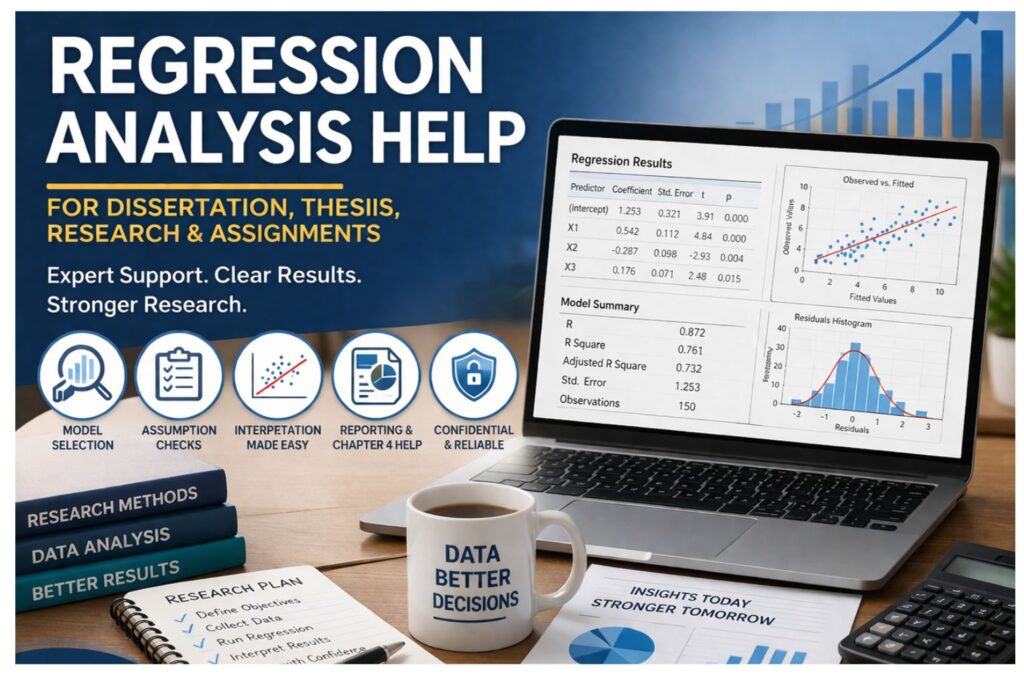
Regression Analysis Help
Regression analysis help is valuable when you need more than a final output and want to understand what your data actually means. Many students and researchers know regression is suitable for their study, but still struggle with choosing the right model, preparing variables, checking assumptions, interpreting coefficients, and presenting the findings clearly. Some need support for dissertations and theses, especially in Chapter 4. Others need help with assignments, journal work, survey studies, or project reports.
At Statistical Analysis Help, we provide clear and practical support with regression analysis for academic and research work. Some clients need help choosing between linear, multiple, logistic, or hierarchical regression. Others already have output from SPSS, R, STATA, or Excel but are unsure how to explain it properly. Some need help with assumptions, coding predictors, model selection, or writing the results in a clear academic style. Whatever the stage of the work, the goal is to make regression analysis easier to understand and easier to report with confidence.
Regression is widely used in quantitative research because it helps answer important questions about prediction, influence, and relationships between variables. It can show whether one variable affects another, how several predictors work together, and how strong an effect appears after other factors are considered. Because of this, regression is powerful, but it can also become confusing when the model or interpretation is unclear. Good support helps ensure that the analysis fits the research question, the results are interpreted correctly, and the findings are presented in a strong and meaningful way.
If your regression model feels confusing or your results chapter still does not feel clear enough, Request a Quote Now and get focused support with model choice, interpretation, and reporting.
Why Regression Analysis Feels Difficult
Regression analysis often looks straightforward at first. Many students are told that it is used to examine prediction or the influence of one or more independent variables on an outcome. In practice, the process is more demanding. A student may know that regression is needed, but still feel unsure about which type of regression fits the study, how to code variables correctly, whether assumptions have been met, and how to explain what the coefficients mean.
The challenge is not only technical. Regression also requires interpretation. A table may contain coefficients, significance values, confidence intervals, model summaries, and diagnostics, yet still leave the student asking what the findings actually mean. This is where many projects slow down. The output exists, but the explanation is still unclear.
The difficulty increases when the study includes several predictors, categorical variables, interaction effects, control variables, or model comparison. In these cases, a regression table can look intimidating, especially when the student is writing a dissertation or thesis and needs the interpretation to be clear, structured, and academically strong. Good support helps break that process into understandable steps so the analysis feels more manageable.
What Regression Analysis Help Includes
Regression analysis help can cover several parts of the process depending on the needs of the project. Some clients need help from the beginning because they are unsure whether regression is the correct method. Others need support after data collection because they want to prepare the variables and structure the model properly. Some already have output and need help understanding the results, checking the assumptions, and presenting the findings clearly in writing.
Support may include help with choosing the right regression model, preparing variables, coding predictors, checking assumptions, handling continuous and categorical variables, interpreting coefficients, understanding significance levels, reviewing model fit, comparing models, and writing findings clearly. It may also include support with reporting the results in dissertation chapters, assignments, journal-style writing, or applied project reports.
The main goal is not simply to run a command. It is to make sure the regression analysis answers the research question clearly and that the interpretation is accurate enough to support academic or professional conclusions.
Help With Choosing the Right Regression Model
One of the most common problems in regression analysis is choosing the right model. Many students know that their study involves prediction, association, or influence, but still feel unsure about which type of regression fits best. Linear regression may be appropriate in one study, while multiple regression, logistic regression, hierarchical regression, or another model may be more suitable in another.
The correct choice depends on the nature of the dependent variable, the number and type of predictors, the structure of the study, and the exact research question being asked. A continuous outcome usually points in one direction. A binary outcome points in another. If the purpose is to see how predictors contribute step by step, a hierarchical approach may be more useful. If the student chooses the wrong model, the findings may become weak or difficult to defend.
Support with model choice helps make that stage clearer. Instead of guessing between similar techniques, the student can work from the actual logic of the study. Once the model fits the research question properly, interpretation becomes easier and the results section becomes more convincing.
Not sure whether your study needs linear, multiple, logistic, or hierarchical regression? Request a Quote Now and get clear guidance on the model that best fits your variables and objectives.
Help With Variable Preparation for Regression
A strong regression model starts with properly prepared variables. Many problems in regression analysis begin before the model is even run. Predictors may be coded poorly, categories may not be set up correctly, missing values may create distortions, or scales may need to be computed before they can be used meaningfully in the model.
Students often struggle with questions such as whether a variable should be treated as continuous or categorical, how dummy coding should be handled, whether scores should be combined into a composite measure, or whether a control variable belongs in the model at all. These decisions matter because they directly affect the meaning of the coefficients and the interpretation of the overall findings.
Support with variable preparation helps build a stronger foundation for the analysis. It makes the model easier to interpret and reduces the risk of confusion later in the results chapter. This is especially useful in survey-based studies, dissertations, and projects that include several independent variables.
Help With Simple and Multiple Regression
Simple and multiple regression are among the most common forms of regression analysis in academic work. Simple regression is often used when the study looks at the effect of one predictor on one outcome. Multiple regression is more useful when several predictors are included and the student wants to understand how they work together.
Many students understand that these models are common, but still feel unsure about what they actually show. A regression coefficient may appear significant, but the student may not know how to explain its direction, size, or meaning in relation to the research question. A model summary may show explained variance, yet the student may still not know how to discuss that properly.
Support with simple and multiple regression helps students move beyond the mechanics of running the model. It helps them understand what the results are saying, how the predictors behave, and how the findings should be presented in clear academic language.
Help With Logistic Regression
Logistic regression is often used when the dependent variable is binary, such as yes or no, success or failure, presence or absence. Although the logic of the model is powerful, many students find logistic regression difficult because the interpretation is less intuitive than ordinary linear regression.
Odds ratios, log-odds, significance tests, and classification results can feel technical and difficult to explain. Students may know that logistic regression is appropriate, yet still feel unsure about how to interpret the coefficients or describe the model clearly in a dissertation, thesis, or assignment.
Support with logistic regression helps make those results more understandable. It helps explain what the coefficients mean, what the odds ratios suggest, whether the predictors are significant, and how the model answers the study question. This is especially useful in health, business, psychology, social science, and public policy research where binary outcomes are common.
Help With Hierarchical Regression
Hierarchical regression is often used when the student wants to enter predictors in steps to examine how much each block adds to the model. This is common in dissertations and theses where the purpose is not only to identify significant predictors, but also to show how explanatory power changes when additional variables are introduced.
Many students find hierarchical regression challenging because it involves both technical setup and layered interpretation. It is not enough to run several models. The student also needs to explain what changed from one step to the next, whether the additional predictors improved the model, and why that improvement matters for the study.
Support with hierarchical regression helps make that process clearer. It helps students understand the logic of block entry, interpret changes in explained variance, and present the results in a way that sounds structured and academically strong. This is especially valuable in studies that involve control variables, demographic factors, or theory-based model building.
Help With Regression Assumptions
Assumptions are one of the most important parts of regression analysis, yet they are also one of the most confusing. Many students know that assumptions matter, but are unsure which ones are relevant, how to check them, and how to report them clearly. Common issues include linearity, independence of errors, homoscedasticity, normality of residuals, and multicollinearity.
If assumptions are ignored, the credibility of the model becomes weaker. If assumptions are discussed without understanding, the results chapter can become unnecessarily technical or unclear. Students often need help deciding what matters for their specific model and how to explain it properly without overwhelming the chapter with detail.
Support with regression assumptions helps make this stage more manageable. It shows how the assumptions relate to the chosen model, what the diagnostics suggest, and how to present that information clearly. This improves the quality of the analysis and gives the results section stronger academic support.
Help With Interpreting Regression Output
Interpretation is one of the biggest reasons people seek regression analysis help. A student may already have the output, yet still feel stuck when trying to explain what the coefficients, p values, standard errors, confidence intervals, R-squared values, or model statistics actually mean. This is especially common in dissertation and thesis work, where the results chapter must do more than repeat a table.
Clear interpretation helps turn the regression output into a meaningful explanation. It shows whether the predictors are significant, whether the direction of the effect is positive or negative, how strong the relationship appears to be, and how the model answers the research question. It also helps explain what the model does not show, which is just as important for honest and accurate reporting.
This stage matters because academic work is judged by more than whether the model was run. It is judged by whether the student understood the findings and explained them clearly. Good support helps make the results section more confident and far easier to defend.
Help With Writing Regression Results in Chapter 4
Many students search for regression analysis help because they are writing Chapter 4 and do not know how to move from output to polished academic writing. They may have regression tables ready, but still feel unsure how to structure the narrative around them. Some include too much raw output. Others include too little explanation. Some repeat numbers without showing what the results mean.
Chapter 4 writing becomes much easier when the regression findings are organized clearly. This often means deciding how to introduce the model, how to report key coefficients, how to summarize model fit, and how to explain the findings in relation to the study objectives or hypotheses. A good results section should be clear, focused, and logically structured rather than crowded with unexplained statistics.
Support with writing regression results helps students turn their analysis into a clear chapter section. It also makes later chapters easier, because strong results writing creates a stronger base for discussion and conclusion.
Help With Regression Analysis for Dissertation and Thesis Research
Regression analysis is especially common in dissertations and theses because many academic studies aim to examine influence, prediction, or explanatory relationships between variables. At this stage, the expectations are higher than in ordinary coursework. The student is expected not only to run the correct model, but also to justify the method, present the findings clearly, and show how the analysis contributes to the wider purpose of the research.
This is why regression analysis can feel more difficult in dissertation work. The model has to make sense academically, the assumptions need to be handled carefully, and the interpretation has to be strong enough for supervisor review. Students often need help making sure the regression section is not only technically sound, but also clear enough to support a convincing Chapter 4.
Projects at this level often connect naturally with help with dissertation statistics, dissertation data analysis help, and research methods and data analysis help, especially when regression is only one part of a larger dissertation process.
Help With Regression Analysis for Assignments and Coursework
Regression is also common in assignments, class projects, and coursework, especially in business, economics, psychology, health sciences, marketing, and data analysis courses. In these settings, students often need help because they understand the basic idea of regression but struggle once they have to apply it to a real dataset and explain the results under deadline pressure.
Support with coursework regression analysis helps students understand what the assignment is asking, what type of model fits the task, and how to write about the output clearly. This is especially useful when the lecturer expects both technical correctness and written interpretation. Even simple assignments can become stressful when the regression table is unclear or the student is unsure how much detail belongs in the answer.
Projects in this category may also connect naturally with statistics help for students, data analysis help, and statistical analysis help when the task goes beyond one model and into broader analysis support.
What You Can Send for Review
Many students and researchers are unsure what to provide when asking for regression analysis help. In practice, support often begins most effectively when you share whatever is directly related to the part of the project that feels unclear. This may include your research objectives, hypotheses, assignment question, dataset, codebook, software output, draft results section, supervisor comments, or notes about the model you are considering.
Some clients only have raw data and a study question. Others already have a full regression table and only need help with interpretation or reporting. Some have been asked to revise an existing model after feedback. Support can begin from many different stages, and it does not require the whole project to be perfectly organized before help becomes useful.
This practical starting point makes the process easier because it focuses on the real problem rather than treating regression analysis as something vague or overly abstract.
What Kind of Support You Receive
Clients often want to know what support will actually look like. The answer depends on the task, but it may include help reviewing the variables, checking whether regression is the right method, choosing the best model, improving the structure of the analysis, handling assumptions, interpreting output, and strengthening the written presentation of the results.
Some clients need help with one focused issue, such as understanding a regression coefficient or deciding whether logistic regression is more appropriate than linear regression. Others need support across several stages, especially when the project includes variable preparation, assumptions, model building, and Chapter 4 writing. In both cases, the aim is to make the regression analysis clearer, stronger, and easier to present confidently.
Support is most valuable when it addresses the actual difficulty within the project rather than staying general. That is what makes the page stronger for both SEO and conversion.
Help With Tight Deadlines and Revision Pressure
Regression analysis often becomes more stressful when the deadline is close. A model may have been delayed because the method was unclear, or the output may exist but the interpretation still feels weak. Some students realize late in the writing process that the regression section does not sound strong enough. Others receive supervisor or lecturer comments asking for clearer explanation, better justification, or stronger treatment of assumptions.
Support during tight deadlines helps bring structure to the work. Instead of spending more time feeling uncertain, the student can focus on the parts that matter most. This might include improving the model explanation, clarifying key predictors, strengthening the reporting, or revising the way the findings are presented.
Urgent support is not only about speed. It is about making the results clearer and more defensible under time pressure. That can make a major difference to the overall quality of the work.
If your regression results still feel unclear and your deadline is close, Request a Quote Now and get focused support with output, assumptions, interpretation, and reporting.
Why Clients Choose Statistical Analysis Help for Regression
Clients choose Statistical Analysis Help because they want regression support that is clear, relevant, and academically useful. They do not want vague descriptions of regression that never solve the real issue in front of them. They want help that addresses the model, the output, the assumptions, the coefficients, and the writing challenges that matter for their project.
We focus on clear explanation, careful interpretation, and practical support that fits the actual structure of the study. Every regression project is different. The dependent variable, the predictors, the research objective, and the reporting expectations all shape what kind of support is useful. That is why focused help is so valuable.
Clients also value support that reduces confusion instead of adding more technical pressure. Once the model is clarified and the findings are explained properly, the whole project often becomes much easier to complete with confidence.
A Clearer Way to Handle Regression Analysis
Regression analysis does not have to remain the part of your project that causes the most confusion. With the right support, model choice becomes clearer, assumptions become easier to handle, coefficients become easier to explain, and the results section becomes much stronger. Most students and researchers do not need more complexity. They need a clearer path through the model they are already trying to use.
At Statistical Analysis Help, we support clients with linear regression, multiple regression, logistic regression, hierarchical regression, assumptions, output interpretation, Chapter 4 writing, and revision after feedback. Whether you are choosing a model, reviewing software output, or trying to make the results section more convincing, practical support can make a real difference.
Need reliable regression analysis help for your dissertation, thesis, assignment, or research project? Request a Quote Now and get clear support with model selection, interpretation, and reporting.
Frequently Asked Questions
What does regression analysis help include?
It includes support with model choice, variable preparation, assumptions, regression output, coefficient interpretation, and clear reporting of findings.
Can you help me choose the right regression model?
Yes. Support can help you decide whether your study needs linear regression, multiple regression, logistic regression, hierarchical regression, or another suitable model.
Do you help with regression assumptions?
Yes. Support is available for common regression assumptions such as linearity, homoscedasticity, normality of residuals, independence, and multicollinearity.
Can you help if I already have regression output?
Yes. Many clients already have software output but need help understanding the coefficients, significance levels, model fit, and written interpretation.
Do you help with dissertation regression analysis?
Yes. Regression support is especially useful in dissertations and theses where Chapter 4, statistical interpretation, and method justification all matter.
Can you help with logistic regression?
Yes. Support is available for logistic regression, including interpretation of coefficients, odds ratios, and model results.
Can you help with urgent regression deadlines?
Yes. Many students and researchers seek help close to submission, and clear guidance can make the regression section much easier to complete.