How to Report ANOVA Results in APA Style
ANOVA results often look complete in the output and unfinished in the final draft. The numbers are there, the table is there, and the significance value is easy to spot, yet the written result still feels weak. In many papers, the problem is not the analysis. The problem is the presentation. A good results section should make the factor under study, the overall test result, the size of the effect, and the pattern across groups easy to understand in a few well-formed sentences.
That difference matters more than it seems. A clear ANOVA paragraph helps the reader follow the logic of the findings without having to decode the software output line by line. In dissertations, theses, assignments, and journal-style reports, that clarity makes the analysis look more controlled and more credible.
Writers who are already working through SPSS analysis help, inferential statistics help, or broader statistical analysis help often reach this stage with the output finished and the wording still unresolved. That is usually where the results section either starts to read well or starts to lose strength.
If the output is ready but the writing still feels unfinished, Request Quotes Now.
The Core APA Structure for ANOVA Results
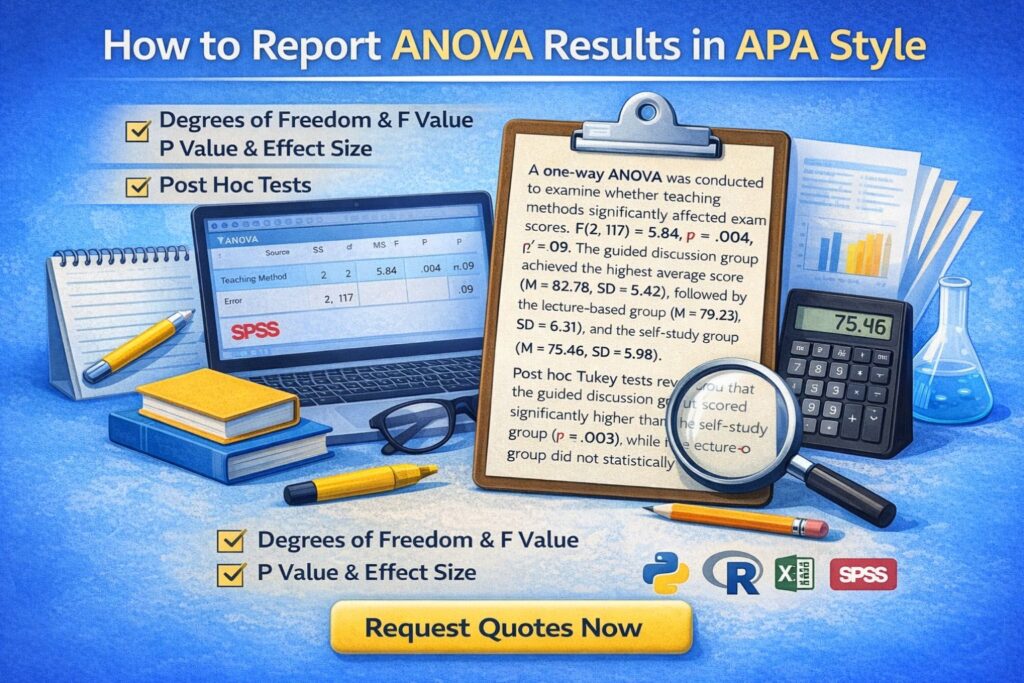
A standard APA-style ANOVA result usually includes the factor or factors tested, the degrees of freedom, the F statistic, the p value, and an effect size such as η² or partial η². In many cases, the paragraph also needs the group means and standard deviations so the reader can see the pattern behind the test rather than only the significance level.
A concise one-way ANOVA result often appears in this form:
There was a statistically significant difference in [outcome] across [groups], F(df1, df2) = x.xx, p = .xxx, η² = .xx.
That structure covers the basic test result. A fuller write-up then adds the descriptive pattern and, where required, the post hoc comparisons.
What a Complete ANOVA Paragraph Should Show
A good ANOVA paragraph does not stop at significance. It gives the reader the essentials in one place.
| Element | What it shows |
|---|---|
| Factor or factors | What was tested |
| Dependent variable | What outcome was measured |
| F statistic and degrees of freedom | The core ANOVA result |
| p value | Whether the effect was statistically significant |
| Effect size | How large the effect was |
| Means and standard deviations | The group pattern |
| Post hoc comparisons | Which groups differed |
When these pieces appear together, the result reads as a complete finding rather than a sentence attached to a table.
Reporting a One-Way ANOVA in APA Style
A one-way ANOVA is used when one categorical independent variable has three or more groups. The opening sentence should make the factor and the outcome clear without forcing the reader to search elsewhere on the page.
A concise version can read like this:
There was a statistically significant difference in satisfaction scores across the three service plans, F(2, 87) = 6.42, p = .002, η² = .13.
That is correct, but a stronger version carries the result a little further:
Satisfaction scores differed significantly across the three service plans, F(2, 87) = 6.42, p = .002, η² = .13. Customers in the premium plan reported the highest satisfaction (M = 4.31, SD = 0.58), followed by the standard plan (M = 3.89, SD = 0.61) and the basic plan (M = 3.52, SD = 0.74).
That version gives the reader both the inferential result and the pattern of the group means, which is usually what makes the paragraph feel complete.
Reporting Post Hoc Results in APA Style
A significant one-way ANOVA shows that at least one mean differs, but it does not identify where the difference lies. That part belongs to the post hoc comparisons.
A clean post hoc sentence looks like this:
Tukey post hoc comparisons showed that the blended-learning group scored significantly higher than the lecture-only group (p = .003) and the self-study group (p = .018), while the difference between the lecture-only and self-study groups was not statistically significant (p = .412).
This part of the write-up often decides whether the results section feels finished. Without it, the reader knows the ANOVA was significant but still does not know which groups actually differed.
When post hoc output is already available and only the wording remains, many writers also find themselves moving between this stage and how to interpret SPSS output or data analysis help.
Reporting a Two-Way ANOVA in APA Style
A two-way ANOVA examines the effects of two categorical independent variables on one quantitative dependent variable. The final paragraph usually reports three parts: the main effect of the first factor, the main effect of the second factor, and the interaction effect.
An example looks like this:
A two-way ANOVA was conducted to examine the effects of study mode and year of study on academic confidence. There was a significant main effect of study mode, F(2, 144) = 4.91, p = .009, partial η² = .06, and a significant main effect of year of study, F(1, 144) = 7.38, p = .007, partial η² = .05. The interaction between study mode and year of study was not statistically significant, F(2, 144) = 1.42, p = .245, partial η² = .02.
The strength of this structure is that each effect is named separately and reported in a controlled order. The paragraph stays readable even when the design is more complex.
Reporting an Interaction Effect in APA Style
An interaction effect should be written in a way that makes the meaning of the interaction visible. The statistic alone is not enough.
A clear example is:
There was a significant interaction between teaching method and assessment type on performance scores, F(2, 180) = 5.27, p = .006, partial η² = .06, indicating that the effect of teaching method varied across assessment formats.
That final clause matters because it tells the reader what the interaction means in plain research language. If relevant, the paragraph can then move into simple-effects analysis, pairwise comparisons, or a figure that makes the pattern easier to see.
Reporting Repeated-Measures ANOVA in APA Style
Repeated-measures ANOVA is used when the same participants are measured across several time points or conditions. The wording should reflect that repeated structure from the start.
A clear example is:
A repeated-measures ANOVA showed a significant effect of time on anxiety scores, F(2, 58) = 8.14, p < .001, partial η² = .22. Anxiety scores decreased from baseline (M = 18.40, SD = 4.10) to mid-intervention (M = 15.93, SD = 3.88) and post-intervention (M = 13.76, SD = 3.52).
The time pattern is visible immediately, which keeps the result grounded in the design rather than sounding like a comparison among unrelated groups.
Reporting a Non-Significant ANOVA Result
A non-significant ANOVA result still needs full reporting. It should read like a complete finding, not a passing note.
A clean example is:
There was no statistically significant difference in workload scores across the four departments, F(3, 96) = 1.27, p = .289, η² = .04.
If the group means help show the observed pattern, they can follow in the same paragraph. A non-significant effect still belongs in the results section and still deserves the same level of care in presentation.
Turning SPSS ANOVA Output Into a Results Paragraph
SPSS output often includes Descriptives, the ANOVA table, Tests of Between-Subjects Effects, and post hoc results depending on the model. The most readable results paragraphs usually follow that same logic in a simplified form: first the group pattern, then the ANOVA result, then the follow-up comparisons when they are needed.
With one-way ANOVA, the results section usually starts with the descriptive pattern and then moves to the post hoc comparisons after the omnibus test. For factorial ANOVA, the main effects and interaction are easier to follow when reported separately. In repeated-measures ANOVA, the time or condition pattern should remain visible throughout the paragraph.
The same part of a project often overlaps with help with dissertation statistics or research statistics help because the issue is rarely the output alone. It is usually the final presentation of the findings inside the chapter.
If you need the results section written cleanly from existing output, Request Quotes Now.
APA Formatting Details for ANOVA Results
Consistency matters throughout the page. Statistical symbols such as F, p, M, and SD should be formatted the same way across the entire section. Decimal places should follow one clear pattern. Very small significance values are usually written as p < .001 rather than awkward software-style output.
The same consistency helps when ANOVA results appear in both prose and tables. The table can support the paragraph, but the paragraph still carries the meaning of the result.
Example of a Polished One-Way ANOVA Paragraph
A one-way ANOVA was conducted to examine whether writing scores differed across three feedback methods. The analysis revealed a statistically significant effect of feedback method on writing scores, F(2, 102) = 7.15, p = .001, η² = .12. Students in the guided-feedback group achieved the highest scores (M = 74.62, SD = 6.44), followed by the peer-feedback group (M = 70.91, SD = 7.18) and the no-feedback group (M = 67.83, SD = 8.02). Tukey post hoc comparisons indicated that the guided-feedback group scored significantly higher than the no-feedback group (p = .001), while the difference between the guided-feedback and peer-feedback groups was not statistically significant (p = .082).
Example of a Polished Two-Way ANOVA Paragraph
A two-way ANOVA was performed to assess the effects of teaching format and assessment type on student engagement. There was a significant main effect of teaching format, F(2, 156) = 5.03, p = .008, partial η² = .06, and a significant main effect of assessment type, F(1, 156) = 6.71, p = .011, partial η² = .04. The interaction between teaching format and assessment type was also significant, F(2, 156) = 4.12, p = .018, partial η² = .05, suggesting that the effect of teaching format on engagement differed depending on assessment type.
Common Mistakes That Weaken ANOVA Reporting
One common problem is giving only the significance value while leaving out the F statistic and the degrees of freedom. Another is stopping after the omnibus ANOVA even though the analysis still needs post hoc comparisons to show which groups differ. Effect size is also often omitted, which makes the result thinner than it needs to be.
In two-way ANOVA, the writing becomes unclear when the main effects and interaction are merged into one loose sentence. In repeated-measures ANOVA, clarity drops when the paragraph stops showing the pattern across time or condition. These are usually writing issues rather than analysis issues, but they affect how the whole section reads.
APA-Style ANOVA Results Table
A simple table can help when several effects need to be displayed together.
| Source | df | F | p | Effect size |
|---|---|---|---|---|
| Teaching method | 2, 117 | 5.84 | .004 | .09 |
| Error | 117 |
For a two-way ANOVA:
| Source | df | F | p | Partial η² |
|---|---|---|---|---|
| Study mode | 2, 144 | 4.91 | .009 | .06 |
| Year of study | 1, 144 | 7.38 | .007 | .05 |
| Study mode × year | 2, 144 | 1.42 | .245 | .02 |
FAQ: How to Report ANOVA Results in APA Style
What should be included in APA-style ANOVA reporting?
A strong ANOVA result usually includes the tested factor, the degrees of freedom, the F statistic, the p value, and an effect size. Means, standard deviations, and post hoc findings are often added where relevant.
How do you report a one-way ANOVA in APA style?
A one-way ANOVA is usually reported by naming the factor and giving the result in the form F(df1, df2) = value, p = value, followed by effect size and a clear summary of the group pattern.
Do you need post hoc tests after ANOVA?
If the omnibus ANOVA is significant and the factor has more than two groups, post hoc testing is usually needed to show which specific groups differ.
How do you report a two-way ANOVA in APA style?
A two-way ANOVA is typically reported by giving the main effect of the first factor, the main effect of the second factor, and the interaction effect separately, each with its own F, degrees of freedom, p, and effect size.
Should effect size be included in ANOVA reporting?
Yes. Effect size helps show the magnitude of the effect, not only whether it was statistically significant.
How should a non-significant ANOVA result be written?
A non-significant ANOVA result should still include the factor tested, the F statistic, the degrees of freedom, and the p value. It should read as a complete result.
Final Thoughts
A strong ANOVA section shows what was tested, what the overall result was, how large the effect was, and where the meaningful differences appeared. When those parts are handled well, the results section reads smoothly and holds together academically.
For help with ANOVA interpretation, post hoc results, SPSS output, or full results chapters, Request Quotes Now.