Outliers are one of the most common issues in research and statistical work. They can affect averages, distort relationships, weaken model accuracy, and lead to misleading conclusions when they are not handled properly. That is why understanding how to deal with outliers in data analysis is an important part of producing reliable results.
Many students, researchers, and professionals discover unusual values in their dataset and immediately face difficult questions. Should the value be removed? Should it be retained? Is it a genuine observation or a data entry mistake? Does it affect the assumptions of the model? These questions matter because poor handling of outliers can damage the credibility of the final analysis.
Outliers can influence averages, distort relationships, weaken model accuracy, and lead to misleading conclusions when they are not handled properly. Careful evaluation is therefore essential before deciding whether an unusual value should be retained, corrected, transformed, or removed. The right decision depends on the nature of the dataset, the research objective, and the statistical method being used. When outliers are assessed properly, the analysis becomes more accurate, more defensible, and easier to report clearly.
What Are Outliers in Data Analysis?
Outliers are observations that appear unusually far from the rest of the data. They may be much higher or much lower than the typical values in the dataset. In some cases, they reflect genuine extreme cases. In other cases, they are caused by data entry errors, measurement mistakes, coding problems, or unusual sampling conditions.
For example, if most participants in a study are between 18 and 65 years old but one record shows an age of 650, that is likely an error rather than a true observation. By contrast, a very high income value in a business dataset might be genuine, even if it is far from the average. The key issue is not simply whether a value looks unusual. The important question is whether it is valid and whether it changes the conclusions of the analysis.
Outliers matter because many statistical methods are sensitive to extreme values. Means, standard deviations, correlations, regressions, and other models can be influenced heavily by a few unusual observations. That is why careful screening is necessary before interpreting final results.
Why Outliers Matter in Research and Statistical Analysis
Outliers can influence your findings in several ways. They may shift the mean upward or downward, inflate the standard deviation, reduce normality, weaken linear relationships, or produce unstable regression coefficients. In some datasets, a small number of extreme cases can make the analysis appear more or less significant than it actually is.
This becomes especially important in dissertation work, research reports, and journal articles, where assumptions must often be checked before the final method is applied. A dataset that appears to violate normality or homoscedasticity may be affected by only a few extreme values. Without proper diagnosis, the researcher may misinterpret the entire structure of the data.
At the same time, not all outliers are bad. Sometimes they reveal important real-world variation. A medical dataset may contain genuine extreme outcomes. A customer spending dataset may include legitimate high-value buyers. Removing such cases without justification may weaken the validity of the study. Good analysis requires balance. Outliers must be examined carefully rather than treated mechanically.
Clients who need expert support with difficult datasets often use dissertation data analysis help when outlier decisions affect the strength of their results chapter or final report.
Common Causes of Outliers
Before deciding what to do with an outlier, it is important to understand how it may have occurred. Outliers are not all created for the same reason, and treatment should depend partly on the cause.
One common cause is data entry error. A misplaced decimal point, an extra zero, or a wrongly coded value can create an observation that looks extreme but is actually incorrect. Another cause is measurement error, where the instrument or collection method produced an inaccurate reading. Sampling variation can also create outliers, especially when the sample includes naturally diverse respondents or rare but valid cases.
Sometimes the outlier is a result of genuine population differences. For example, in organizational research, one department may perform very differently from the rest. In social science data, one respondent may have an unusually high score because their lived experience is truly different from the sample average. In these cases, the outlier may contain useful information rather than noise.
Understanding the source of the unusual value helps guide the decision about whether to correct it, retain it, transform it, or analyze it separately.
How to Identify Outliers in a Dataset
The first step in handling unusual observations is proper detection. Outlier identification should combine visual inspection with statistical criteria, because relying on only one method may be misleading.
A simple starting point is to review descriptive statistics. Minimum and maximum values can reveal suspicious observations quickly. Frequencies and sorted data can also show values that fall far outside the expected range. Visual tools such as boxplots, histograms, and scatterplots are especially useful because they make extreme values easier to see in context.
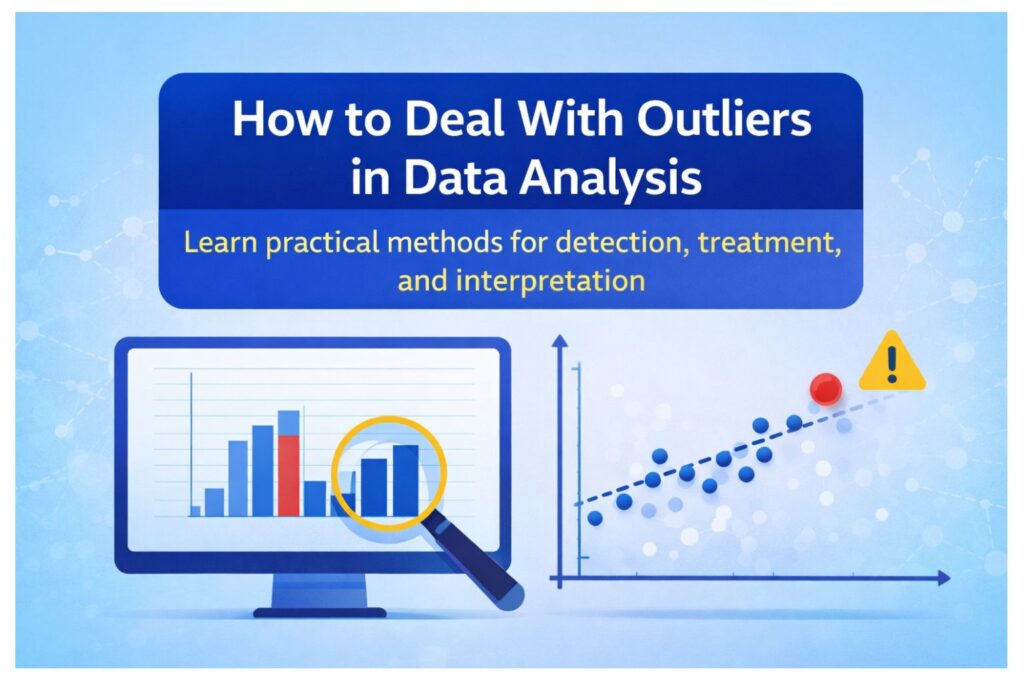
Boxplots are one of the most common tools for identifying outliers. Values outside the whiskers may indicate moderate or extreme unusual cases. Scatterplots are also valuable when examining relationships between variables because they can show whether a small number of observations are driving a trend. Histograms help assess whether an extreme tail is influencing the shape of the distribution.
In addition to visual methods, researchers often use statistical rules such as z-scores, the interquartile range rule, leverage values, Cook’s distance, or Mahalanobis distance depending on the type of analysis. The correct choice depends on whether you are screening a single variable or evaluating multivariate influence in a model.
Using Z-Scores to Detect Outliers
Z-scores are a common way to identify unusual observations in continuous data. A z-score shows how far a value is from the mean in standard deviation units. Observations with very large positive or negative z-scores may be potential outliers.
In practice, researchers often use thresholds such as plus or minus 3.00, though some use stricter or more flexible cutoffs depending on the sample size and field of study. A value beyond this range may deserve further investigation, but it should not automatically be removed. The z-score only shows that the value is unusual relative to the distribution.
This method works best when the data is approximately normal. If the distribution is heavily skewed, z-scores may be less informative, and other methods may be more appropriate. Even so, z-scores remain useful as an initial screening tool, especially in academic projects using standard statistical software.
Using the Interquartile Range Rule
Another widely used method is the interquartile range rule. This approach identifies values that fall far below the first quartile or far above the third quartile. The distance between these quartiles is called the interquartile range, and values beyond a multiple of that range are often flagged as outliers.
This method is especially useful because it is less influenced by extreme values than the mean and standard deviation. It is commonly used in boxplots and is helpful for skewed data where z-scores may be less reliable. Values outside 1.5 times the interquartile range are often considered potential outliers, while more extreme cutoffs may identify severe outliers.
The interquartile range method is a good practical option for survey data, questionnaire scales, and general research datasets. It offers a balance between simplicity and robustness.
How Outliers Affect Different Statistical Methods
Outliers do not affect every method in the same way. Some analyses are highly sensitive to extreme values, while others are more robust. This is why treatment decisions should always consider the method you plan to use.
Within descriptive statistics, outliers can distort the mean and standard deviation, making the data appear more variable than it really is for most participants. In correlation analysis, a single unusual point may make a relationship look stronger or weaker than it actually is. Regression models can also be affected, as outliers may influence slope estimates, residual patterns, and overall model fit. This can change the interpretation of predictors and make the results unstable.
Group comparison methods such as t tests and ANOVA can also be affected, especially when the extreme value changes group means or violates assumptions. Nonparametric tests are often less sensitive because they rely on ranks rather than raw values. Medians and interquartile ranges are also more resistant to outlier influence than means and standard deviations.
For this reason, the question is not simply whether an outlier exists. The more important question is whether it meaningfully changes the result you are trying to interpret.
Should You Remove Outliers?
This is one of the most common questions in statistical work, and the answer is not always simple. Outliers should not be removed automatically. Deletion is justified only when there is a strong reason, such as clear data entry error, invalid measurement, or evidence that the case does not belong to the target population.
If the unusual value is genuine, removing it may reduce the validity of the study. Real data often contains extreme cases, and part of good analysis is being able to deal with that reality appropriately. Removing valid values only because they make the results inconvenient is poor practice and can bias the findings.
A better approach is to investigate the observation first. Check the raw data, confirm the coding, review collection notes, and assess whether the case is plausible. Then examine whether the value changes the results substantially. In many cases, researchers compare analyses with and without the outlier to understand its effect. This provides a more defensible basis for decision-making.
When deletion is necessary, it should be explained transparently in the methods or results section.
Practical Ways to Deal with Outliers
There are several ways to handle outliers, and the most suitable option depends on the cause, the analysis type, and the research objective.
One option is correction. If the unusual value is due to data entry or coding error, correcting it is usually the best response. Another option is retention. When the value is genuine and important to the research question, keeping it may be appropriate. In such cases, you may still acknowledge its influence and use robust interpretation.
Transformation is another common strategy. Logarithmic, square root, or other transformations may reduce skewness and limit the influence of extreme values, especially in positively skewed variables such as income, sales, or time data. Winsorization is sometimes used to reduce the impact of extreme observations by replacing them with less extreme values at a chosen cutoff. This approach should be used carefully and reported clearly.
A further option is to choose a more robust method. Nonparametric tests, robust regression, median-based summaries, or bootstrapping may be better choices when outliers are genuine but influential. The best solution is often not to force the data into a conventional model but to choose a model that fits the data more realistically.
Projects that require careful model selection and clean reporting often benefit from expert Data Analysis Help, especially when unusual values are affecting assumptions or interpretation.
How to Report Outliers in Academic Writing
Once you identify and evaluate outliers, the next step is reporting them properly. Transparency is important because readers, supervisors, and reviewers need to understand how data screening decisions were made. In academic writing, report how outliers were identified, what criteria were used, and what action was taken. Where values were corrected, explain the reason for the change. When cases were removed, state why they were considered invalid. If outliers were retained, mention that they were examined and clarify why they were kept. Where relevant, also note whether analyses were compared with and without the unusual cases.
This strengthens the credibility of the study because it shows that the researcher handled the issue thoughtfully rather than ignoring it. Clear reporting is especially important in dissertations, theses, journal articles, and policy reports where methodological rigor matters.
Outliers in Survey and Questionnaire Data
Outliers in survey data often appear in age, income, experience, time spent, score totals, or composite scale values. In questionnaire research, the challenge is sometimes not a single extreme item but an unusual total score or a participant whose response pattern is inconsistent with the rest of the sample.
This requires careful checking. A highly unusual total score may reflect real attitude differences, random responding, poor understanding of the questionnaire, or data entry issues. Outliers in survey research should therefore be interpreted in light of the content of the study, not just the number itself.
When working with survey data, descriptive checks, boxplots, and reliability screening can be especially helpful. If your project involves Likert-scale data, group comparisons, or regression models built from questionnaire responses, it is important to evaluate extreme cases before final interpretation.
If you are working with questionnaire results in academic research, Request Quote Now.
Common Mistakes When Dealing with Outliers
One common mistake is deleting all unusual values without checking whether they are valid. Another is ignoring obvious extreme cases because dealing with them feels difficult or time-consuming. Some researchers also rely on a single rule and treat it as absolute, even when the data structure suggests a more flexible interpretation is needed.
Another problem is failing to report what was done. Even when the treatment decision is reasonable, the analysis becomes weaker if the method section does not explain it. Poor reporting creates doubt about the reliability of the results.
A further mistake is focusing too much on the outlier itself and too little on its actual effect. Some unusual values look dramatic but make little difference to the model, while others have strong influence even if they are not visually extreme. That is why influence diagnostics and sensitivity checks are often more useful than visual judgment alone.
When to Get Professional Help with Outlier Treatment
Outlier decisions can become difficult when the dataset is large, the model is complex, or the stakes of the research are high. This is especially true in dissertations, advanced quantitative studies, business forecasting, and publication work. A poor decision at this stage can affect every result that follows.
Professional support can help when you are unsure whether a value is an error, whether a transformation is appropriate, whether the model assumptions are being distorted, or how to explain the treatment clearly in academic writing. Expert review is also useful when you need to compare alternative approaches and choose the most defensible one.
If you need help screening your dataset, checking assumptions, or writing the findings professionally, Request Quote Now.
Conclusion
Understanding how to deal with outliers in data analysis is essential for producing trustworthy results. Outliers can distort summary measures, affect model assumptions, and change final conclusions, but they should never be handled automatically. The right approach begins with careful detection, continues with thoughtful evaluation, and ends with clear reporting.
Some outliers are errors that should be corrected or removed. Others are genuine observations that should be retained and interpreted carefully. The best decision depends on the validity of the case, the purpose of the analysis, and the method being used. Strong analysis is not about making the data look neat. It is about understanding the data honestly and choosing the most appropriate treatment.
If you need help reviewing extreme values, selecting the right method, or interpreting your results clearly, Request Quote Now.
Frequently Asked Questions
What is an outlier in data analysis?
An outlier is a value that lies unusually far from the rest of the observations in a dataset. It may be caused by error or may represent a genuine extreme case.
Should outliers always be removed?
No. Outliers should only be removed when there is a clear justification, such as data entry error, invalid measurement, or evidence that the case does not belong to the target population.
How can I identify outliers?
Common methods include boxplots, histograms, scatterplots, z-scores, the interquartile range rule, and influence statistics such as Cook’s distance or Mahalanobis distance.
Why are outliers important in regression analysis?
Outliers can influence slope estimates, residuals, significance values, and model fit. A small number of extreme cases may change the interpretation of predictors substantially.
What is the best way to deal with outliers?
The best approach depends on the cause and the analysis type. Possible options include correction, retention, transformation, winsorization, or the use of robust statistical methods.
Can outliers affect normality?
Yes. Extreme values can make a distribution appear more skewed or heavy-tailed, which may affect tests and models that rely on normality assumptions.
How do I report outliers in a dissertation or research paper?
Explain how they were identified, what criteria were used, what treatment was applied, and why that decision was appropriate for the study.
Are outliers always errors?
No. Some outliers are genuine observations that reflect real-world variation. They should be evaluated carefully rather than removed automatically.