
Dissertation Statistician
Dissertation Statistician A dissertation statistician helps you make sense of the most technical part of your dissertation: the data analysis. When the proposal is approved, the data is collected, and the results chapter is waiting, the statistical side can quickly become stressful. The research questions must match the right tests. The variables must be coded […]
Dissertation Statistician
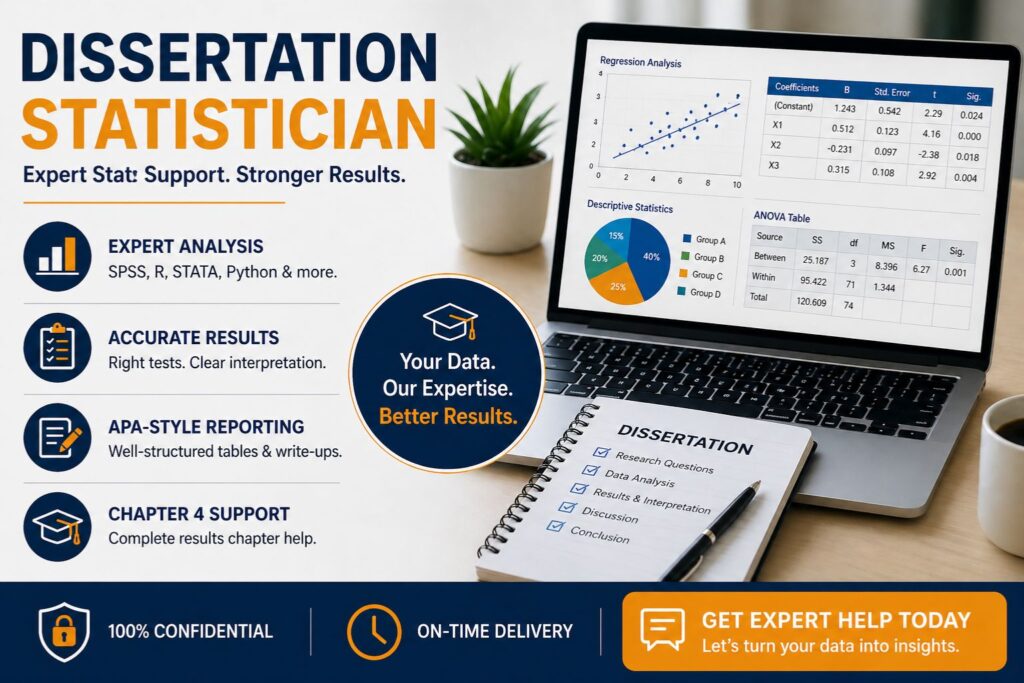
A dissertation statistician helps you make sense of the most technical part of your dissertation: the data analysis. When the proposal is approved, the data is collected, and the results chapter is waiting, the statistical side can quickly become stressful. The research questions must match the right tests. The variables must be coded correctly. The assumptions must be checked. The tables must be clear. The interpretation must answer the study questions without sounding vague or overcomplicated.
At Statistical Analysis Help, we provide dissertation statistician support for students and researchers who need clear, accurate, and well-structured statistical analysis. Whether your project involves SPSS, R, STATA, Excel, Python, Jamovi, JASP, AMOS, SmartPLS, or another tool, the goal is the same: to help you produce results that are correct, readable, and suitable for academic review.
If your dissertation is at the analysis stage, you can Request Quotes Now and share your topic, research questions, dataset, and deadline.
Dissertation Statistician Help for Accurate Research Results
A strong dissertation depends on alignment. Your research questions, hypotheses, variables, sample size, instruments, methodology, statistical tests, and interpretation must all work together. If one part is weak, the results chapter can become difficult to defend.
Many students do not struggle because they lack effort. They struggle because dissertation statistics require technical decisions that are not always obvious. Many students do not struggle because they lack effort. They struggle because dissertation statistics require technical decisions that are not always obvious. For example, comparing two groups may require a t test, while comparing more than two groups may call for ANOVA. When the goal is to examine relationships, correlation or regression may be suitable. For categorical outcomes, logistic regression or chi-square analysis may be more appropriate. In studies using multi-item survey scales, reliability testing may be needed before the main analysis is completed.
A dissertation statistician helps you avoid guesswork. Instead of choosing a method because it looks familiar, the analysis is selected based on the structure of your data and the purpose of your study.
If your project mainly involves software output and interpretation, our SPSS data analysis help page may also be useful.
Why Work With a Dissertation Statistician?
A dissertation statistician provides more than software output. The work involves selecting the right method, preparing the dataset, checking assumptions, running the analysis, interpreting the findings, and presenting results in a format that fits academic expectations.
This matters because dissertation committees often focus closely on the statistical chapter. They may ask why a test was chosen, whether assumptions were checked, whether the sample size was suitable, whether the interpretation matches the result, or whether the conclusions go beyond the evidence.
Strong statistical support helps you present your findings with confidence. It also reduces the risk of avoidable revisions caused by unclear analysis, poor reporting, wrong tests, or weak interpretation.
What Our Dissertation Statistician Support Includes
| Area of Support | What We Help With |
|---|---|
| Research question review | Matching research questions and hypotheses to suitable statistical methods |
| Data preparation | Cleaning, coding, labeling, screening, missing data review, and outlier checks |
| Descriptive statistics | Frequencies, percentages, means, standard deviations, tables, and charts |
| Assumption testing | Normality, homogeneity, multicollinearity, linearity, independence, and diagnostics |
| Inferential analysis | t tests, ANOVA, chi-square, correlation, regression, ANCOVA, MANOVA, and related methods |
| Advanced analysis | Mediation, moderation, logistic regression, factor analysis, SEM, and scale validation |
| APA reporting | Clear statistical write-ups, tables, figures, and results formatting |
| Chapter 4 support | Results chapter structure, interpretation, and research-question-based reporting |
| Revision support | Responding to supervisor, chair, committee, or reviewer comments |
Dissertation Statistician for Chapter 4 Results
Chapter 4 is one of the most important parts of a dissertation because it presents the evidence from the study. It should not read like copied software output. It should be organized, objective, and directly connected to the research questions.
A strong results chapter usually includes an introduction, data screening, participant or sample characteristics, descriptive statistics, assumption testing, main analysis, tables, figures, and a summary of findings. The exact structure depends on your university guidelines, but the logic should remain clear.
We help organize the results so that each research question is answered properly. The tables are presented clearly, the statistical values are reported correctly, and the interpretation explains what the findings mean without overstating the results.
For broader results-section support, visit our dissertation data analysis help page.
Dissertation Statistician for Quantitative Research
Quantitative dissertations require careful planning and accurate execution. The analysis must reflect the study design, data type, measurement level, and research purpose. A mismatch between the method and the research question can weaken the entire dissertation.
We support quantitative dissertations in education, psychology, business, nursing, public health, healthcare, social sciences, management, finance, marketing, and related fields. Some studies need simple descriptive statistics. Others need regression, mediation, moderation, factor analysis, or advanced modeling.
Survey-based dissertations may require coding, reverse coding, reliability analysis, composite score creation, descriptive summaries, correlation, regression, and interpretation. Experimental and quasi-experimental studies may require group comparisons, pre-test and post-test analysis, or repeated measures procedures.
If your study is based on questionnaire or survey responses, you may also need survey data analysis services.
Help Choosing the Right Statistical Test
Choosing the correct statistical test is one of the most common challenges in dissertation research. The right method depends on the research question, dependent variable, independent variable, number of groups, measurement scale, data distribution, and assumptions.
| Research Question Type | Possible Statistical Method |
|---|---|
| What are the sample characteristics? | Descriptive statistics |
| Are two continuous variables related? | Pearson or Spearman correlation |
| Do two groups differ? | Independent samples t test or Mann-Whitney U test |
| Do three or more groups differ? | ANOVA or Kruskal-Wallis test |
| Are categorical variables associated? | Chi-square test |
| What predicts a continuous outcome? | Multiple linear regression |
| What predicts a binary outcome? | Logistic regression |
| Does one variable explain a relationship? | Mediation analysis |
| Does a relationship change under different conditions? | Moderation analysis |
| Are scale items internally consistent? | Reliability analysis |
| Can many items be reduced into factors? | Exploratory factor analysis |
If your dissertation focuses mainly on testing hypotheses, our hypothesis testing help page gives more focused support.
Dissertation Statistician for SPSS, R, STATA, Python, and Excel
Different dissertations require different software. SPSS is common in psychology, education, nursing, and social science research. R is useful for advanced modeling, visualization, and reproducible analysis. STATA is often used in economics, public health, and policy research. Python is useful for data cleaning, automation, visualization, and advanced workflows. Excel is helpful for organizing and reviewing datasets.
| Software | Common Dissertation Uses |
|---|---|
| SPSS | Survey analysis, descriptive statistics, t tests, ANOVA, regression, reliability, factor analysis |
| R / RStudio | Advanced statistics, visualization, reproducible analysis, statistical programming |
| STATA | Regression, panel data, public health, economics, survey analysis |
| Excel | Data cleaning, coding, summaries, charts, and initial organization |
| Python | Data cleaning, automation, visualization, modeling, reproducible workflows |
| AMOS / SmartPLS | SEM, CFA, path analysis, and latent variable modeling |
| Jamovi / JASP | User-friendly statistical testing and academic reporting |
| Minitab | Applied statistics, quality analysis, and engineering-related research |
You can also explore our RStudio help, STATA Assignment help, and Python assignment help pages if your project requires specific software support.
Dissertation Statistician for Regression Analysis
Regression analysis is widely used in dissertation research because many studies examine prediction, influence, or relationships between variables. The type of regression depends on the outcome variable and the research question.
Linear regression may be suitable when the dependent variable is continuous. Logistic regression may be suitable when the outcome is binary. Hierarchical regression may be used when predictors are entered in blocks. Multiple regression may be used when several independent variables are examined together.
We help with model selection, assumption testing, coefficient interpretation, model fit, tables, and APA-style reporting. The goal is to make the regression results understandable and defensible.
For focused support, visit our regression analysis help page.
Dissertation Statistician for Mediation and Moderation
Mediation and moderation are common in psychology, business, education, public health, and social science dissertations. They are often mentioned together, but they answer different questions.
Mediation examines whether one variable helps explain the relationship between an independent variable and an outcome. Moderation examines whether the strength or direction of a relationship changes depending on another variable.
We help structure mediation and moderation analysis, prepare variables, create interaction terms, interpret indirect effects, explain confidence intervals, and report results clearly. If your dissertation uses PROCESS, regression-based mediation, moderation, or conditional process analysis, we can help make the output easier to understand.
For related support, see our moderation analysis in SPSS page.
Data Cleaning and Preparation
Good dissertation statistics begin with clean data. Before analysis, the dataset must be reviewed for missing values, duplicate entries, incorrect coding, outliers, inconsistent labels, and unsuitable variable formats.
For survey research, data preparation may include reverse coding, creating composite scores, checking scale direction, labeling values, reviewing incomplete responses, and testing reliability. For secondary data, preparation may involve merging files, removing errors, transforming variables, and checking data consistency.
Clean data improves the quality of the analysis and reduces the risk of misleading results. It also makes the final results easier to explain.
Assumption Testing and Diagnostics
Many statistical tests depend on assumptions. These assumptions help determine whether the method is suitable and whether the findings can be interpreted confidently.
Depending on the analysis, assumption testing may include normality, linearity, homogeneity of variance, independence, multicollinearity, influential cases, residual patterns, and model fit. When assumptions are not met, alternative methods or careful explanations may be needed.
Assumption testing strengthens your dissertation because it shows that the analysis was not chosen blindly. It gives your committee a clearer reason to trust the method used.
APA-Style Dissertation Results Reporting
APA-style reporting requires clear statistical presentation. A good results section does not simply list p-values. It explains the test used, the values obtained, the direction of the finding, and the meaning of the result in relation to the research question.
A t test may require means, standard deviations, t value, degrees of freedom, p-value, and effect size. A regression model may require R², F statistic, coefficients, standard errors, p-values, and interpretation. A chi-square test may require the chi-square value, degrees of freedom, p-value, and effect size such as Cramer’s V.
We help present results in a clean academic format so the analysis is easier to read and easier to defend.
Dissertation Statistician for Non-Significant Results
Non-significant results can feel disappointing, but they do not mean the dissertation has failed. Many valid studies produce non-significant findings. What matters is how the results are reported and interpreted.
A non-significant finding should be explained honestly. It means the analysis did not provide enough evidence to support the hypothesis. The discussion can then connect the result to the sample, measurement, theory, previous studies, limitations, or future research.
We help present non-significant results professionally. The aim is not to force significance. The aim is to make the findings accurate, clear, and academically acceptable.
Dissertation Statistician for Revisions
Statistics-related revisions can be stressful, especially when feedback comes from a supervisor, chair, committee, or reviewer. Comments may ask for clearer assumptions, different tests, better tables, stronger interpretation, additional analysis, or improved alignment between research questions and results.
We help review the feedback and make practical corrections. This may involve revising the analysis plan, rerunning tests, improving tables, adding diagnostics, rewriting results, or clarifying why a method was appropriate.
Revision support is especially useful when you are close to submission and need the statistical section polished.
Dissertation Statistician for Different Research Fields
Dissertation statistics differ across fields. A nursing dissertation may focus on patient outcomes, intervention effectiveness, or DNP project evaluation. An education dissertation may examine student performance, teacher practices, leadership, or program outcomes. A psychology dissertation may involve validated scales, group comparisons, regression, mediation, or moderation.
Business and management dissertations often examine leadership, employee performance, customer behavior, marketing, operations, finance, or organizational outcomes. Public health dissertations may involve prevalence, risk factors, logistic regression, survey data, or program evaluation.
We adapt the statistical support to your field, research design, software, and university expectations.
Common Dissertation Statistics Problems We Help Fix
| Problem | How We Help |
|---|---|
| Unclear research questions | Refine the link between research questions, hypotheses, and analysis |
| Wrong statistical test | Select a method that fits the variables and study design |
| Messy dataset | Clean, code, label, and prepare the data |
| Weak interpretation | Explain results clearly and academically |
| Poor Chapter 4 structure | Organize findings by research question or hypothesis |
| Missing assumption tests | Add relevant diagnostics and explain the results |
| Committee feedback | Revise analysis and reporting based on comments |
| Non-significant findings | Report results honestly and professionally |
| APA formatting issues | Improve statistical tables and written results |
Confidential Dissertation Statistics Support
Dissertation work is sensitive. Your topic, data, university materials, and research documents should be handled carefully. We provide professional support that respects your work and focuses on helping you complete the statistical section responsibly.
You remain in control of your dissertation. Our role is to help you understand the statistical work, improve the quality of the analysis, and present the results clearly.
Dissertation Statistician Pricing
The cost of dissertation statistician help depends on the project scope. A simple analysis with clean data may require less time than a full dissertation project involving data cleaning, scale construction, assumption testing, several models, APA tables, and Chapter 4 writing.
Pricing may depend on the number of research questions, the number of variables, the complexity of the analysis, the software required, the condition of the dataset, the level of interpretation needed, and the deadline.
To receive a clear quote, share your research questions, hypotheses, methodology, dataset format, university guidelines, and deadline.
Why Choose Statistical Analysis Help?
Statistical Analysis Help focuses on clear, accurate, and dissertation-ready analysis. The support is practical, structured, and based on your actual research problem.
You get help connecting the topic, research questions, methodology, dataset, analysis, interpretation, and final write-up. The goal is to make the statistical section easier to understand, easier to present, and stronger for academic review.
This support is especially useful if you need more than software output. You receive help with the logic behind the analysis, the meaning of the results, and the wording needed for a strong dissertation chapter.
Get Help From a Dissertation Statistician
If your dissertation statistics feel confusing, unclear, or difficult to complete, expert support can help you move forward. Whether you need help choosing the right test, cleaning data, running SPSS, interpreting regression, writing Chapter 4, or responding to revision comments, the right statistical support can make the process clearer.
Send your research details, dataset, software requirements, and deadline to get started.
Dissertation Statistician FAQs
What does a dissertation statistician do?
A dissertation statistician helps with statistical planning, data cleaning, test selection, data analysis, assumption testing, output interpretation, APA-style reporting, and results chapter support.
Can a dissertation statistician help me choose the right test?
Yes. The correct test depends on your research questions, hypotheses, variables, measurement scale, data type, and study design.
Can you help with SPSS dissertation analysis?
Yes. We help with SPSS data cleaning, descriptive statistics, t tests, ANOVA, chi-square, correlation, regression, reliability analysis, factor analysis, mediation, moderation, and APA-style reporting.
Can you help with Chapter 4?
Yes. We help organize Chapter 4, present statistical tables, interpret findings, report assumptions, and structure results by research question or hypothesis.
Can you help if my results are not significant?
Yes. Non-significant results can still be reported clearly and professionally. We help explain them accurately without forcing conclusions.
Do you help with dissertation revisions?
Yes. We can help revise the statistical analysis, tables, interpretation, and results chapter based on supervisor, chair, committee, or reviewer feedback.
Do you help with PhD, DBA, EdD, DNP, and master’s dissertations?
Yes. We support PhD dissertations, DBA projects, EdD dissertations, DNP projects, master’s theses, and applied research projects.
Can you work with survey data?
Yes. We help with survey coding, missing data review, reliability testing, composite scores, descriptive statistics, regression, mediation, moderation, and interpretation.
What software do you support?
We support SPSS, R, STATA, Python, Excel, Jamovi, JASP, AMOS, SmartPLS, Minitab, and other statistical tools depending on the project.
How do I request dissertation statistician help?
You can send your research questions, hypotheses, methodology, dataset format, university guidelines, and deadline through the quote page.