How to Report Regression Results in APA Format
Knowing how to report regression results in APA format is important because running the analysis is only one part of the work. Many students and researchers manage to produce regression output in SPSS, R, STATA, or Excel, but then struggle when it is time to write the results section. The tables may be correct, yet the reporting still feels uncertain. Questions usually come quickly. Which values should be included? How should the coefficients be written? Do the assumptions need to be mentioned? Should the ANOVA table be discussed? What does an APA-style regression paragraph actually look like?
This is where many dissertations, theses, assignments, and journal drafts become weak. The statistical work may be acceptable, but the presentation of the findings is too vague, too technical, or too incomplete. A strong results section should not look like software output pasted into a document. It should read like a clear academic explanation of what the model tested, what it found, and why that matters.
A good regression write-up in APA format usually includes the purpose of the model, the overall model fit, the amount of variance explained, the significance of the model, the coefficients for the predictors, and a clear explanation of the direction and meaning of the effects. Once that is done well, the results section becomes easier to follow and much more credible. If you need expert help with regression analysis, interpretation, or academic reporting, Request Quote Now.
What Does APA Format Mean for Regression Results?
APA format means reporting statistical findings in a clear, structured, and academically consistent way. It does not mean copying every number from the software output. It means selecting the most important values, presenting them accurately, and explaining them in sentences that the reader can understand.
For regression, APA reporting usually focuses on the parts of the model that actually answer the research question. That includes whether the regression model was statistically significant, how much variance it explained, and which predictors made significant contributions. Where relevant, it also includes confidence intervals, standardized coefficients, and assumption checks.
The goal is not to impress the reader with too many numbers. The goal is to present the right numbers and explain them clearly.
This topic fits naturally with broader pages such as regression analysis help, SPSS analysis help, and Chapter 4 results help because many readers who search this topic are already at the reporting stage of their project.
Why Students Often Struggle With Reporting Regression Results
Regression output can feel overwhelming because it usually includes several tables. A simple model may produce a Model Summary, ANOVA table, Coefficients table, residual information, collinearity statistics, and assumption checks. Students often do not know which values belong in the final write-up and which ones can stay in the appendix or be left out entirely.
Another common problem is reporting the numbers without explaining their meaning. A weak results section may state that the model was significant and list the coefficients, but never explain what the predictors actually mean in relation to the outcome variable. In other cases, the interpretation is too informal and does not sound academic enough for dissertation or journal writing.
APA-style reporting solves that problem by giving structure to the write-up. It helps the researcher move from raw output to a polished findings section.
What to Include When Reporting Regression Results in APA Format
A good regression results section usually includes a few core elements. The exact details depend on whether the model is simple linear regression, multiple regression, hierarchical regression, or logistic regression, but the general structure is similar.
Table 1. Main Elements to Include in APA Regression Reporting
| Element | What it shows | Why it matters |
|---|---|---|
| Purpose of the analysis | What the model tested | Gives context to the results |
| Overall model fit | F statistic and p value | Shows whether the model is significant |
| Variance explained | R² and adjusted R² | Shows how much of the outcome is explained |
| Regression coefficients | B, SE, Beta, t, p | Shows the contribution of each predictor |
| Confidence intervals if used | Likely range of the effect | Strengthens interpretation |
| Assumption note | Whether assumptions were met | Supports the validity of the model |
This structure helps keep the write-up focused and professional.
The Basic APA Structure for Reporting Regression Results
A polished APA regression paragraph usually follows a simple flow. It begins by stating why the regression was performed. It then reports whether the model was significant, how much variance it explained, and which predictors were significant. Finally, it explains the direction of the effects in plain academic language.
A common sequence looks like this:
A multiple regression was conducted to examine whether X, Y, and Z predicted outcome A.
The overall model was significant.
The model explained a certain percentage of the variance.
Specific predictors were significant or non-significant.
The direction of each significant relationship was described.
That structure works well because it tells the reader what was tested, what the model found, and which variables mattered most.
How to Report the Model Summary in APA Format
The Model Summary table is one of the most important parts of regression output. It usually contains R, R², adjusted R², and the standard error of the estimate. In APA reporting, the most commonly used values are R² and adjusted R².
R² shows how much variance in the dependent variable is explained by the predictors in the model. Adjusted R² is often preferred in multiple regression because it accounts for the number of predictors and gives a more realistic estimate.
A good write-up does not just report these values. It explains them. For example, saying that the model explained 32% of the variance in academic performance is much clearer than only writing R² = .32.
Table 2. Model Summary Values and How to Report Them
| Value | Meaning | Example reporting style |
|---|---|---|
| R² | Proportion of variance explained | The model explained 32% of the variance |
| Adjusted R² | Adjusted estimate of variance explained | The adjusted model explained 30% of the variance |
| Standard error of estimate | Average prediction error | Usually optional unless especially relevant |
How to Report the ANOVA Table in APA Format
The ANOVA table in regression shows whether the overall model is statistically significant. This is the part that tells the reader whether the predictors, taken together, significantly predict the outcome variable.
In APA format, the main values usually reported from this table are the F statistic, the degrees of freedom, and the p value.
A clean example looks like this:
The regression model was statistically significant, F(3, 196) = 18.47, p < .001.
That one sentence tells the reader that the model as a whole was significant. It is often reported before discussing the individual coefficients.
How to Report Coefficients in APA Format
The Coefficients table is usually the most important part of regression reporting because it shows which predictors had significant effects and what direction those effects took.
In APA style, the main values typically reported are the unstandardized coefficient B, its standard error, the standardized coefficient Beta when relevant, the t value, and the p value. Some writers also include confidence intervals, especially in journal manuscripts or advanced academic work.
The interpretation should explain whether each predictor had a positive or negative relationship with the outcome and whether that predictor was statistically significant.
Table 3. Main Coefficient Values in APA Reporting
| Value | Meaning | Why it matters |
|---|---|---|
| B | Unstandardized effect | Shows expected change in outcome |
| SE | Standard error of B | Shows precision of the estimate |
| Beta | Standardized effect | Helps compare predictors |
| t | Test statistic | Shows whether the predictor contributes significantly |
| p | Significance value | Shows whether the predictor is significant |
A strong sentence might read like this:
Time management was a significant positive predictor of academic performance, B = 0.42, SE = 0.10, Beta = .31, t = 4.20, p < .001.
That is much stronger than simply saying the variable was significant.
Example of How to Report Simple Linear Regression in APA Format
Simple linear regression is used when one predictor is used to predict one outcome variable. The APA structure is usually straightforward because the model contains only one independent variable.
Example Paragraph
A simple linear regression was conducted to examine whether study time predicted exam score. The model was statistically significant, F(1, 98) = 24.56, p < .001, and explained 20% of the variance in exam score, R² = .20. Study time was a significant positive predictor of exam score, B = 3.12, SE = 0.63, Beta = .45, t = 4.96, p < .001, indicating that higher study time was associated with higher exam scores.
This works well because it includes the purpose, model fit, variance explained, coefficient, and interpretation.
Example of How to Report Multiple Regression in APA Format
Multiple regression is used when several predictors are included in the same model. The APA write-up should report the overall model first and then the individual predictors.
Example Paragraph
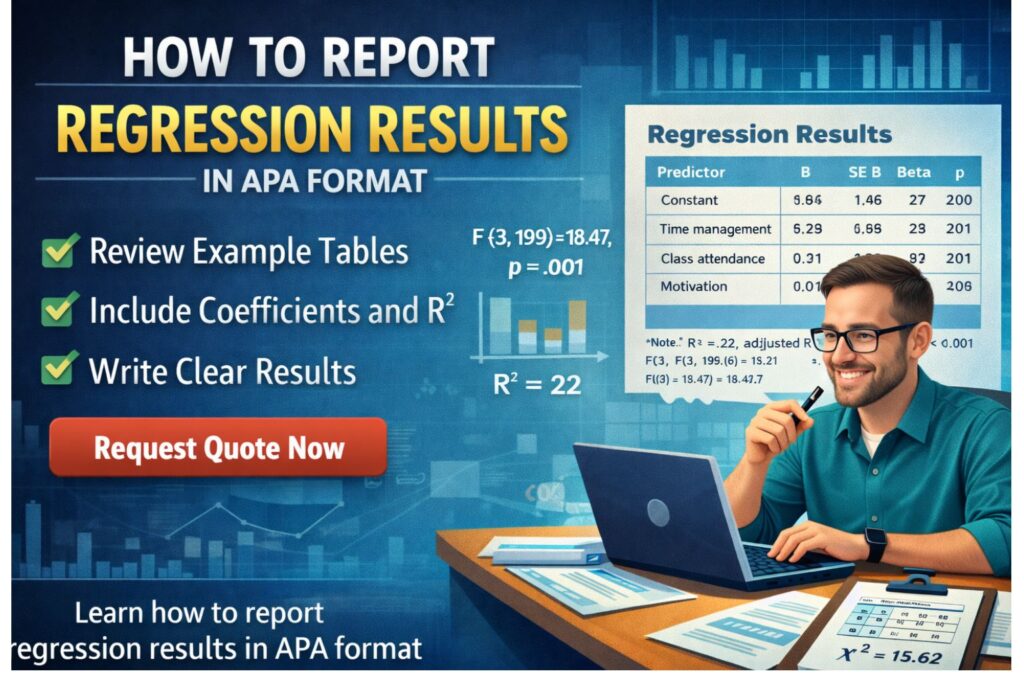
A multiple regression was conducted to examine whether time management, class attendance, and motivation predicted academic performance. The overall model was statistically significant, F(3, 196) = 18.47, p < .001, and explained 22% of the variance in academic performance, R² = .22, adjusted R² = .21. Time management was a significant positive predictor, B = 0.38, SE = 0.09, Beta = .29, t = 4.22, p < .001, and motivation was also a significant positive predictor, B = 0.25, SE = 0.08, Beta = .21, t = 3.13, p = .002. Class attendance was not a significant predictor, B = 0.11, SE = 0.07, Beta = .10, t = 1.57, p = .118.
This style is clean because it separates the model-level results from the variable-level results.
Example of How to Report Hierarchical Regression in APA Format
Hierarchical regression is often used when predictors are entered in blocks. In APA format, it is important to report the contribution of each step and whether the addition of new predictors explained extra variance.
Example Paragraph
A hierarchical multiple regression was conducted to examine whether motivation predicted academic performance after controlling for age and gender. In Step 1, age and gender explained 6% of the variance in academic performance, R² = .06, F(2, 197) = 6.31, p = .002. After motivation was added in Step 2, the model explained 18% of the variance, R² = .18, ΔR² = .12, F(3, 196) = 14.37, p < .001. Motivation made a significant positive contribution to the model, B = 0.41, SE = 0.09, Beta = .35, t = 4.56, p < .001.
This type of write-up is especially useful in dissertation work where the researcher wants to show the added value of specific predictors.
Should Assumptions Be Reported in APA Regression Results?
Yes, at least briefly. Regression assumptions are important because they affect whether the findings can be trusted. Common assumptions include linearity, independence of errors, homoscedasticity, normality of residuals, and absence of multicollinearity in multiple regression.
You do not always need to write a long paragraph about them in the main results section, but it is good practice to mention that the assumptions were checked and that no major violations were found. If there were important issues, they should be acknowledged clearly.
A simple APA-style sentence might be:
Preliminary analyses indicated that the assumptions of linear regression were adequately met, including linearity, normality of residuals, homoscedasticity, and absence of problematic multicollinearity.
This is especially useful in dissertations and theses where examiners often look for assumption checks.
How to Present Regression Results in an APA Table
In many academic papers, regression results are reported both in the text and in a table. The table gives the reader a clean summary, while the paragraph explains the main findings in words.
A typical APA regression table includes the predictor names and columns for B, SE, Beta, t, and p. Some versions also include confidence intervals.
Table 4. Sample APA Regression Results Table
| Predictor | B | SE B | Beta | t | p |
|---|---|---|---|---|---|
| Constant | 12.40 | 2.15 | — | 5.77 | < .001 |
| Time management | 0.38 | 0.09 | .29 | 4.22 | < .001 |
| Class attendance | 0.11 | 0.07 | .10 | 1.57 | .118 |
| Motivation | 0.25 | 0.08 | .21 | 3.13 | .002 |
Note. R² = .22, adjusted R² = .21, F(3, 196) = 18.47, p < .001.
This format is simple, readable, and close to what many supervisors expect.
Common Mistakes When Reporting Regression Results in APA Format
One common mistake is reporting only that the model was significant without mentioning how much variance it explained. Another is listing coefficients without explaining whether they were positive or negative. Some writers also include too many software details that do not improve understanding, while others leave out the values that matter most.
Another frequent problem is confusing B and Beta. The unstandardized coefficient B is useful for explaining how much the dependent variable changes when the predictor increases by one unit. The standardized coefficient Beta is useful for comparing the relative strength of predictors measured on different scales.
Students also often forget to report non-significant predictors. These should not be ignored if they were part of the model. They should be reported honestly and briefly.
How to Make Regression Reporting Sound More Academic
A strong results section uses clear academic language. It should not sound like software output, and it should not sound too casual. Instead of saying a variable had a big effect, it is better to say it was a significant positive predictor. Instead of saying the result worked, it is better to say the model was statistically significant.
Good academic reporting also avoids overstatement. A statistically significant coefficient does not automatically mean that the effect is large or practically important. The interpretation should stay close to what the numbers actually support.
This is where related pages such as how to interpret SPSS output, dissertation data analysis help, and academic writing help for results chapters can strengthen the internal structure of the site.
A Simple Template for Reporting Regression Results in APA Format
Many students find it easier when they have a reusable structure. Here is a simple format you can adapt.
Table 5. APA Regression Reporting Template
| Section | What to write |
|---|---|
| Purpose | State why the regression was conducted |
| Overall model | Report F, df, p |
| Variance explained | Report R² and adjusted R² |
| Coefficients | Report B, SE, Beta, t, p for each predictor |
| Interpretation | Explain which predictors were significant and in what direction |
| Assumptions | Mention whether assumptions were checked and met |
Example Template Sentence
A multiple regression was conducted to examine whether [predictors] predicted [outcome]. The overall model was statistically significant, F([df1], [df2]) = [value], p = [value], and explained [percentage]% of the variance in [outcome], R² = [value], adjusted R² = [value]. Among the predictors, [predictor] was a significant positive predictor, B = [value], SE = [value], Beta = [value], t = [value], p = [value], whereas [predictor] was not a significant predictor, p = [value].
That structure is strong because it keeps the reporting clear and complete.
Why This Matters in Chapter 4 and Dissertation Writing
Regression is one of the most commonly used methods in dissertations, theses, and research projects. It is often central to the study because it helps answer predictive questions and test hypotheses about influence or effect. That means the reporting needs to be accurate, clear, and academically defensible.
In Chapter 4, a weak regression write-up can make a good analysis look incomplete. A strong write-up shows that the researcher understands not only how to run the model but also how to explain it properly. This matters for grades, supervisor confidence, examiner feedback, and publication quality.
If your regression output is ready but the writing still feels difficult, Request Quote Now.
Get Help Reporting Regression Results Correctly
Many students and researchers do not need help running the regression itself. They need help reading the output, selecting the right values, building an APA table, and writing the results section clearly. That stage matters because it is the point where analysis becomes evidence.
Support can include checking assumptions, interpreting coefficients, writing regression results in APA style, formatting tables, and preparing Chapter 4 or journal-ready reporting. This is especially useful when the output looks confusing, the supervisor wants revisions, or the findings need to sound more polished and academically strong.
For expert support with reporting, interpretation, and results writing, Request Quote Now.
Why Choose Statistical Analysis Help
At Statistical Analysis Help, the goal is not only to run statistical tests but also to help clients explain them properly. Regression reporting often becomes difficult because it requires both technical understanding and strong academic writing. That combination matters in assignments, theses, dissertations, and research manuscripts.
Support can include regression analysis help, SPSS analysis help, Chapter 4 results help, data analysis help, and related services designed to make statistical reporting clearer and more defensible.
If you want your regression results presented in a way that sounds professional, accurate, and submission-ready, this is the right place to start.
FAQ: How to Report Regression Results in APA Format
What should be included when reporting regression results in APA format?
You should usually include the purpose of the model, the overall model fit, the F statistic, p value, R², adjusted R², the coefficients for predictors, and a clear interpretation of the results.
Do I need to report both R² and adjusted R²?
In multiple regression, it is often a good idea to report both. Adjusted R² is especially useful because it accounts for the number of predictors in the model.
Should non-significant predictors be reported?
Yes. If a predictor was included in the model, it should usually be reported even if it was not statistically significant.
Do I need to mention regression assumptions in APA format?
Yes, at least briefly. It is good practice to state that the assumptions were checked and that no serious violations were found, or to mention any important issues if they existed.
What is the difference between B and Beta in regression reporting?
B is the unstandardized coefficient and shows the expected change in the outcome for a one-unit increase in the predictor. Beta is the standardized coefficient and is useful for comparing the relative strength of predictors.
Can I copy the SPSS regression table directly into my paper?
It is better to create a cleaner APA-style table. SPSS output is useful for analysis, but it usually needs to be reformatted for academic reporting.
How do I write regression results in a dissertation?
Start by explaining why the regression was conducted, then report the overall model, the variance explained, the predictor coefficients, and a short interpretation linked to the research question.
Can you help write my regression results in APA format?
Yes. Support can include interpreting output, formatting tables, checking assumptions, and writing clear regression results for assignments, dissertations, theses, and manuscripts.
Final Call to Action
Learning how to report regression results in APA format can make a major difference in the quality of your results chapter or research paper. A clear APA write-up shows that you understand the model, the findings, and the academic standards expected in higher-level research.
If you need help turning regression output into a polished APA-style results section, get expert support from Statistical Analysis Help today.